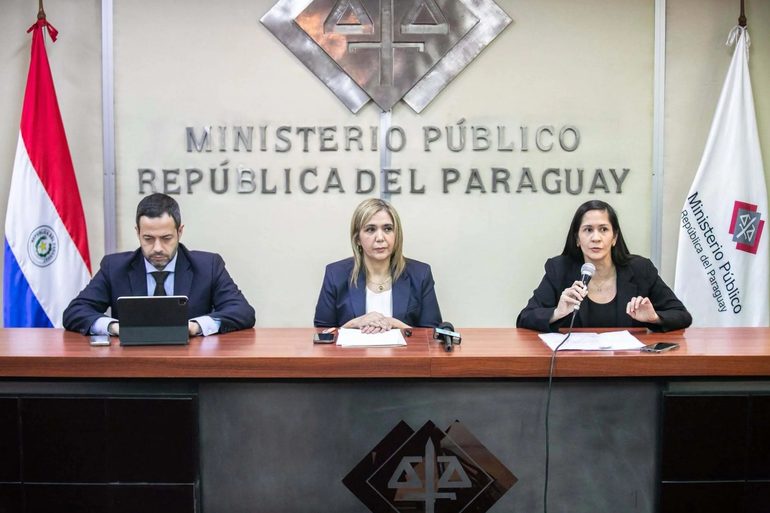

Paraguay’s Public Prosecutor’s Office expanded the charges against former president Santiago Peña under criminal association as a perpetrator in the Ueno Bank case. The expansion covers former Central Bank of Paraguay president Carlos Carvallo, former banks superintendent Holger Insfrán and three board members arrested on Friday 13 November 2026.
According to the charges they allegedly formed an organised hierarchical structure within the state apparatus itself.
The permanent purpose, as the prosecutor states, was “to subordinate the financial system” and “control bodies to the interests of the Vázquez Group and Ueno Bank conglomerate”.
“Cross-ownership links” and “clandestine meetings”
The president allegedly maintained cross-ownership interests through shares, bonds and family members linked in offshore structures. The prosecution argues that former president Peña allegedly acted as head of this structure.
According to the prosecutor, he “allegedly held regular clandestine meetings at the presidential residence Mburuvicha Róga with Federico Miguel Vázquez to coordinate the conglomerate’s needs”. Former president Peña also allegedly “issued public and institutional directives not to intervene in the entity” and “suppressed media reports of insolvency”.
“Illicit payments” and investigation extension
According to the indictment, former president Peña personally received illicit payments. The document mentions the discovery and delivery of US$200,000 in cash in envelopes inside the official residence.
The indictment requests that the three former board members arrested on Friday also be held in pretrial detention. It argues the existence of concrete facts that reasonably support a risk of flight or obstruction of a specific investigative act. The Prosecutor’s Office is requesting pretrial detention for Marco Aurelio González and house arrest for Liana Caballero and Miguel Ángel Mora.
The prosecution also requested a six-month extension to continue the investigative proceedings. These include the analysis of documents, technical reports and financial transactions as well as requests for international legal cooperation.
The Ueno Bank case
Ueno Bank, a rapidly expanding digital lender that reached nearly three million customers, entered formal resolution on 3 November 2026 after the Central Bank of Paraguay determined that its solvency ratio had fallen below half the required minimum. Between 2023 and 2026 the bank received substantial deposits and placements from public and pension entities.
Investigations allege that the bank carried out irregular credit operations with companies linked to its economic group, while public and pension funds, including those of the Social Security Institute (IPS), remained placed there. Former President Santiago Peña has been linked to decisions on the placement and renewal of such funds and to prior shareholding in Ueno Holding.
The collapse has prompted criminal charges against multiple individuals for offences including breach of trust, asset freezes, and ongoing fiscal inquiries.