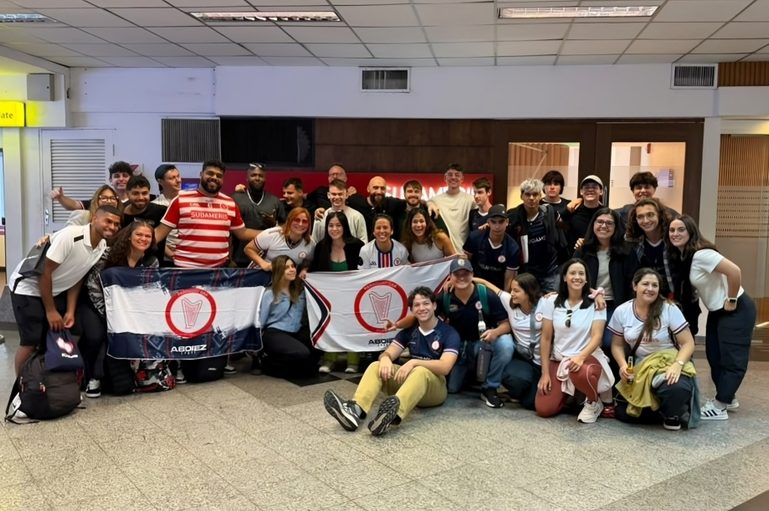

Paraguay will send three teams across the border to compete in the Copa Almirante Brown on Saturday, 14 November 2026, in San Isidro, Argentina. The Gaelic Football tournament will feature 12 men’s teams and six women’s teams, making it one of the region’s largest gatherings for the sport. Paraguay’s Las Arpas (The Harps) will be represented by two men’s teams, divided into Rojo (Red) and Azul (Blue), and one women’s team.
The Paraguayan delegation will comprise 36 players, with additional coaching staff. The tournament runs from approximately 14:30 to 20:30 across two pitches simultaneously. Last year, Paraguay GAA’s main team stormed to third at the Copa Almirante Brown in what was Paraguay’s international debut.
A growing presence on the international stage
Paraguay’s expanded participation for the 2026 edition marks a significant step forward from last year’s competition. In 2025, the country sent one men’s team and a partial women’s squad, whose players joined forces with athletes from Chile to compete as a combined side. This year, Paraguay will field a full women’s team alongside two men’s teams.
For the players, the tournament also represents an opportunity to compete internationally and experience a different country. Some members of the delegation will be travelling outside Paraguay for the first time, while others will be boarding an aeroplane for the first time.
“It is just amazing to see what opportunities sport can provide to people,” Paraguay GAA player Andrew Kaminsky tells The Asunción Times, reflecting on the significance of the trip.
Life after the World Games
The team has spent the past few months preparing for the competition, training three times a week on Wednesday and Friday evenings and Sunday mornings. Although there was a brief pause following their return from the World Games in Ireland, training quickly resumed.
The trip has been made possible in part through the team’s monthly membership fees, paid by players to participate in training and tournaments, as well as sponsorship from Sudameris Bank, its principal financial supporter.
| Gaelic football is one of Ireland’s national sports and is governed worldwide by the Gaelic Athletic Association (GAA). Played on a large grass pitch with H-shaped goalposts, the game combines elements of football, rugby, and basketball. Players can kick, hand-pass, and carry the ball while advancing towards the goal. Teams score either a point by sending the ball over the crossbar or a goal by striking it into the net beneath the crossbar, with a goal worth three points. |
A full day of competition at Gaelic tournament
The Copa Almirante Brown will follow a group-stage format before moving into knockout matches, with each fixture lasting 16 minutes: two seven-minute halves separated by a two-minute interval. Four minutes are allocated between matches, and no team will play in consecutive time slots.
On the men’s side, the 12 participating teams will be divided into four groups of three. Each team will play the other two sides in its group before progressing to a knockout competition determined by its finishing position.
Paraguay’s Rojo team will face two Buenos Aires sides, Hurling Club and Bullfin, in the group stage. Azul will compete in a separate group, leaving open the possibility of an all-Paraguayan meeting later in the competition.
“There is a possibility two Paraguayan sides could meet in the final, although the group-stage draw means they will begin the tournament separately,” Kaminsky explains.
The women’s Gaelic tournament will feature six teams divided into two groups of three, with each side playing the other two teams in its group before entering the corresponding trophy competition.
Three trophies in a knockout tournament
Teams will compete for different trophies depending on their finishing positions in the group stage. In the women’s competition, the highest-ranked sides will contest the Fragata Hércules trophy, while the Foxford and Buenos Aires trophies will also be awarded. On the men’s side, the principal prize is the Independencia trophy, alongside the Foxford and Buenos Aires competitions.
Both categories will follow the same basic knockout structure within their respective trophy divisions. The four group winners in the men’s competition will enter the Independencia bracket, the four runners-up will compete for the Foxford, and the third-placed teams will contest the Buenos Aires trophy.
Each bracket will feature semi-finals, followed by a final and a third-place match. A draw in a knockout fixture will be settled by a golden point: teams change ends, and the first side to score either a point or a goal wins.
Scoring also differs from conventional football. A goal is worth three points on the scoreboard, while a point is worth one. Group-stage victories earn two competition points, draws earn one and defeats earn none.
More than a tournament
The Paraguayan delegation traveled to Buenos Aires on Thursday afternoon, with players staying at a hostel in the San Telmo neighbourhood. Friday was left largely open for exploring the city. The group also has a dinner planned for Sunday evening, following the Gaelic tournament.
Buenos Aires has become a focal point for Gaelic football in South America, despite the sport remaining relatively uncommon across the continent. The annual Copa Almirante Brown provides an opportunity for clubs from different countries to compete, build connections and develop the game beyond its traditional strongholds.
For Paraguay, the increase from a combined team last year to three independent squads this November reflects the progress made by the local Gaelic football community. But the significance of the trip extends beyond the results on the pitch. With players experiencing international travel for the first time and the possibility of an all-Paraguayan final, Saturday’s competition will offer the delegation a chance to measure its sporting progress while creating experiences that reach well beyond the tournament itself.