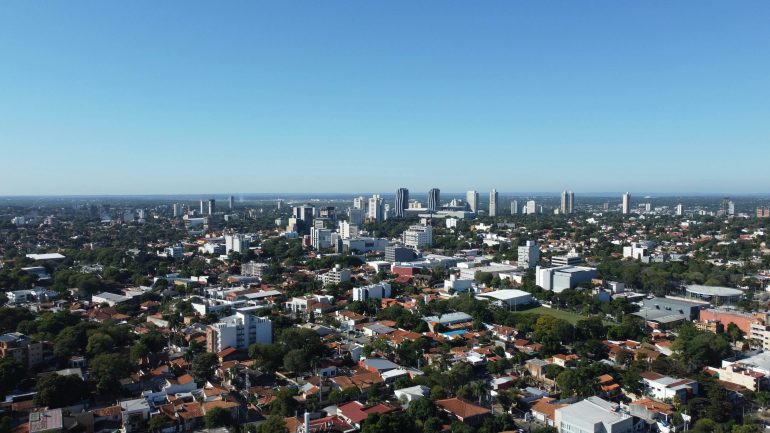

Asunción has been ranked the sixth most liveable city in Latin America. This ranking comes from the Global Liveability Index 2026, the annual study produced by the Economist Intelligence Unit (EIU), the research arm linked to The Economist magazine. Paraguay’s capital placed 102nd out of 173 cities assessed worldwide, scoring 57.4 out of 100.
Methodology behind the ranking
The EIU produces the study every year by scoring cities against more than 30 indicators. The index groups these into five categories: stability, healthcare, culture and environment, education, and infrastructure. The organisation does not rely exclusively on statistics. It supplements hard data with assessments from analysts and contributors based in each city.
That mix of local insight and measurable fact is what pushes a city up or down the table from one year to the next, and it is what ultimately shaped Asunción’s result on the 2026 Global Liveability Index.
Where Asunción gains and loses points
A breakdown of Asunción’s score shows a clear pattern. Infrastructure was its strongest category, at 64.3 out of 100, followed by culture and environment, at 60, and education, at 58.3.
Stability and healthcare pulled the city down, scoring 55 and 50 respectively. The report identifies these as the main obstacles to a higher ranking. It also highlights public security, institutional stability and the quality of health services as the areas most in need of improvement. For a closer look at how security plays out on the ground, The Asunción Times has mapped out safety across the city’s neighbourhoods.
A strong showing against bigger cities
Despite a much smaller population than most of its regional peers, Asunción outscored several of Latin America’s largest and best-known metropolitan centres, including São Paulo (118th), Rio de Janeiro (119th), Mexico City (125th) and Bogotá (129th). It also ranked ahead of Quito, San José, Panama City, Medellín, San Salvador, and Caracas.
The city remains well behind the region’s five best performers, however. Buenos Aires led the Latin American table, ranking 62nd worldwide with a score of 76.1. Santiago de Chile followed closely on 76.0, ahead of San Juan in Puerto Rico on 73.6, Montevideo on 73.4, and Lima on 59.6.
This is not the only global ranking to place Asunción in the mix with much larger cities. Oxford Economics’ Global Cities Index placed the city 468th out of 1,000 last year, using a broader set of economic and quality-of-life indicators.
Top positions in the Global Liveability Index
Copenhagen, the capital of Denmark, kept its position as the world’s most liveable city, scoring a near-perfect 98 out of 100 thanks to top marks in stability, education and infrastructure. Vienna, in Austria, and Melbourne, in Australia, shared second and third place, each on 97.
Sydney, Zurich, Geneva, Osaka, Adelaide, Vancouver and Tokyo completed the global top ten.
Worldwide, the average score on the Global Liveability Index held steady at 76.1, unchanged from the previous year. Declines in stability and culture were offset by gains in healthcare, education and infrastructure, the EIU said.
Latin America still trails other regions
Regionally, Western Europe remained the most liveable part of the world, averaging 92 points, ahead of North America on 90. Latin America averaged 67. This placed it behind Asia on 74 and Eastern Europe on 71. It remained ahead of the Middle East and North Africa on 61, and Sub-Saharan Africa on 55.
Set against that regional average, Asunción’s own score of 57.4 still lags behind the Latin American mean. Even so, its climb past several of the region’s largest capitals suggests that the gap is not fixed. Steady gains in infrastructure and public services could push the city further up the table in future editions.