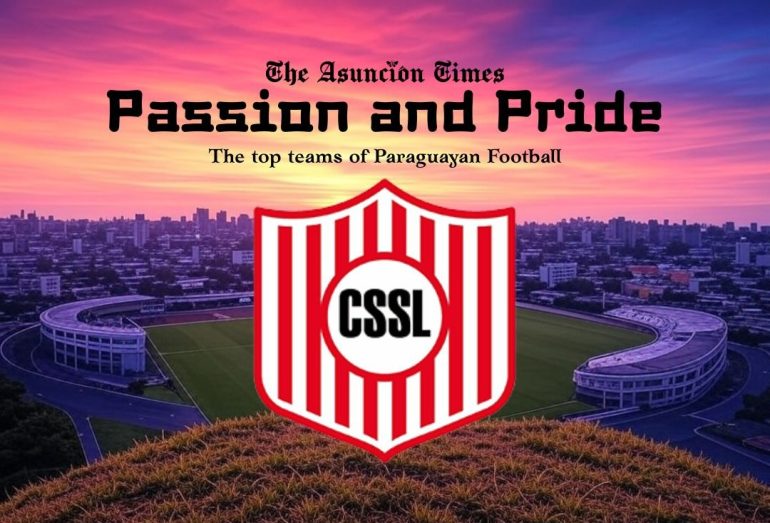

Welcome to our exciting series Passion and Pride, where we dive into the heart of Paraguayan football, spotlighting the 12 teams of the Primera División. In each episode, we introduce you to one club, uncovering their rich histories, fierce rivalries and special moments that have shaped Paraguay’s top league. In part fourteen of Passion and Pride, we move to Gran Asunción to meet San Lorenzo, one of the newly promoted teams for the 2026 season.
The San Lorenzo identity
Club Sportivo San Lorenzo was founded in 1930 under the name Tacuary Sport, which lasted only a few months. The club was later renamed Sportivo Villa Cálcena, a name it kept until 1936. Cálcena refers to Gregorio Cálcena, the man who donated the land on which the club’s stadium was built.
When players returned from the Chaco War in 1936, the institution adopted its current name: Club Sportivo San Lorenzo. The change symbolised a new stage for the club, closely linked to its city and its people.
San Lorenzo’s shirts feature red and white vertical stripes, giving rise to their nickname Rayadito or “the Striped”. The most popular story behind these colours dates back to the year of the club’s foundation. A club member travelled to Asunción to buy kits, intending to purchase the same colours worn by Cerro Porteño. However, the shop did not have enough stock. Instead, the owner offered red-and-white striped shirts.
Coincidentally, these were the same colours as the city’s flag. When the club’s board saw the shirts, they approved them immediately. Since then, San Lorenzo has worn its characteristic red and white stripes. The club is also known as the Saint, a reference to its name.
A traditional team
San Lorenzo is considered one of the traditional teams of Paraguayan football. The club plays its home matches at the Günther Vogel Stadium, located in the city of San Lorenzo, just outside Asunción. The stadium has a capacity of 6,200 spectators and was known as Ciudad Universitaria until 2011, when it was renamed in honour of a local businessman who supported the club.
Throughout its history, San Lorenzo has fielded teams and players that remain in the memory of Paraguayan football supporters. At the same time, the club is no stranger to hardship. It has experienced multiple relegations and has even competed in the third division of Paraguayan football.
After four years away from the top flight, San Lorenzo returned to the Primera División for the 2026 season. Coached by former Olimpia player and Uruguay international Sergio Orteman, the club’s immediate objective is clear: survival. Deeply rooted in its city, San Lorenzo (near Asunción) understands that it plays not only for points, but for the pride of its community. That sense of belonging has been key to its repeated returns to the top tier.
Derbies and a curious anecdote
San Lorenzo has two notable rivalries. One is the “Saints Derby” against Deportivo Santaní, a rivalry born in the second division. Also often referred as the “Route Derby” due to the geographical proximity of the two cities and the religious reference in both club names.
Its fiercest rivalry, however, is against Sportivo Luqueño. Known as the Metropolitan Derby, it pits two popular clubs from neighbouring cities within the Gran Asunción area against each other. More than football, local pride is always at stake.
One of the most curious incidents in Paraguayan football history occurred during a match between these two sides in 2001. When a San Lorenzo striker was injured, two Luqueño stretcher bearers attempted to assist him. Poor coordination led to the player being dropped to the ground. San Lorenzo’s players believed the act to be intentional and reacted angrily, sparking a brawl that quickly became a global football blooper, widely circulated in international media.
Fighting to stay
San Lorenzo’s return to the Primera División is yet another chapter in a history defined by resilience and identity. Promotion is not the end of the journey, but the beginning of a demanding season in which every match becomes a test of character.
The objective is clear: to remain in the top flight. San Lorenzo does not return with grand promises, but with the conviction of a club that knows the terrain, understands the struggle and embraces it as part of its nature. Staying in the Primera División would not mark a sporting achievement. It would confirm that San Lorenzo still belongs among the historic teams of Paraguayan football, not only by nostalgia, but by presence.
To follow the club, find San Lorenzo on Instagram.
Read the previous Episode 13 of Passion and Pride, about Rubio Ñu, a historic neighbourhood club that returned to the Primera División in 2026 after eight years away.