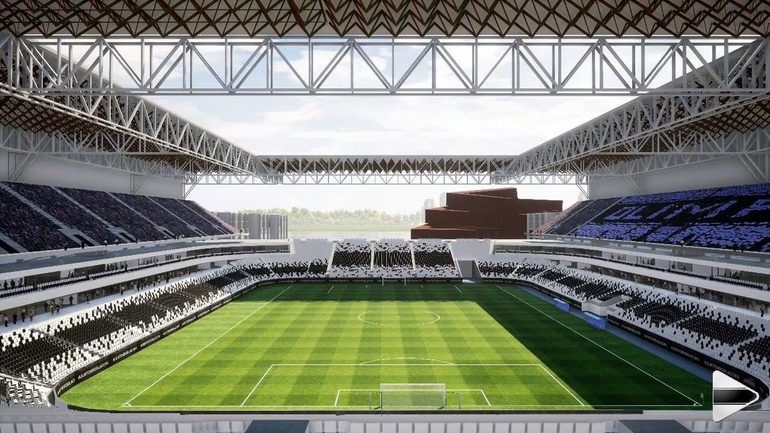

Club Olimpia recently clinched its 49th Paraguayan football title, but the Asunción based club could not celebrate at home. Olimpia has demolished its historic stadium on the Para Uno site to build a much larger one in the same place. The new Estadio Osvaldo Domínguez Dibb is due to open in 2029, and also meant to host a match at the 2030 World Cup.
Yet the stadium project remains shadowed by questions over how far construction has really advanced, whether the published timetable can still be met, and how the club will fill the financing and sponsorship gaps left by the collapse of Ueno bank.
In this article, The Asunción Times delves into the ground’s history, the scale and funding of the new stadium, the limited progress reported so far, the impact of the bank’s resolution, and the next phases that must be completed if Olimpia is to return to Para Uno in time for its 127th anniversary and the 2030 World Cup fixture.
A club and a ground with history
Olimpia was founded in Asunción in 1902. It is one of Paraguay’s most successful clubs and the only one to have won the Copa Libertadores, South America’s leading club competition. Its old ground opened in 1965 with a friendly against Santos, the Brazilian side then featuring Pelé.
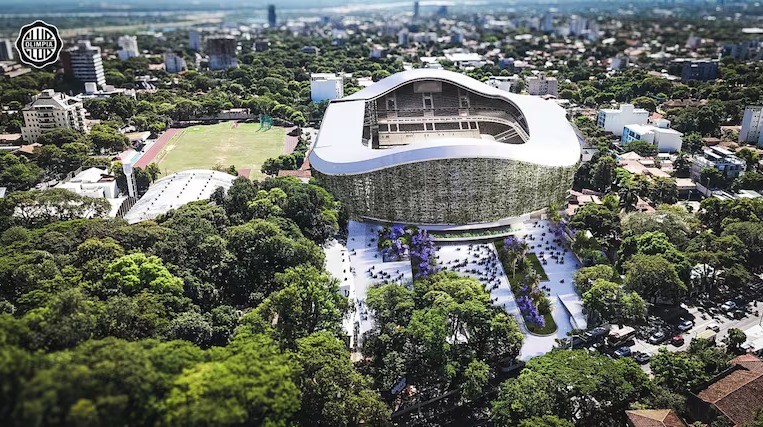
Fans know the ground as El Bosque de Para Uno, or the Para Uno woods, because of the tall trees around it. Para Uno is also the name locals give to the area of Asunción where it stands. The new stadium is planned to seat 46,000, a much larger capacity than the old ground.
The plan for a new Para Uno
The new stadium keeps the name the club gave its old ground in 2024, in honour of former president Osvaldo Domínguez Dibb. Olimpia presented the project for its new stadium in July 2026. According to the club, it envisions 46,000 seats, an estimated investment of US$80 million and an opening in the second half of 2029. The design aims to meet international standards.
The 2030 World Cup will be played mainly in Spain, Portugal and Morocco, with opening matches in Paraguay, Argentina and Uruguay. Paraguay’s match is assigned to the new stadium. That is why the project matters well beyond the club and its supporters.
According to the club, the US$80 million estimate includes US$16.2 million for nine neighbouring properties. Local reports break down the funding as US$20 million from CONMEBOL, South America’s football confederation, around US$31 million from commercial use of the complex and nearly US$11 million from corporate boxes. A Brazilian consultancy, ARENA Events + Venues, is assigned technical supervision of the works. The design is by PATH URBAN.
How the project has progressed
Demolition and excavation of the old stadium are complete. In July 2026, the club reported that the first phase, covering initial earthworks and retaining structures, had ended. The second phase is to include levelling, further containment work, piles and foundations. Asunción’s municipal government approved the plans on 29 July 2026.
In September, club officials and CONMEBOL inspected the site. They said the project was following its timetable.
For months the site was an open excavation, and supporters grew anxious. The official schedule now calls for the stands to be finished by 31 May 2028. The whole stadium is due to be handed over in June 2029, a year before the World Cup.
It is worth being precise about what this means. In July, the club stated design and planning were about 75% complete, which is not the same as construction. At that point, only 20% of the planned contracts had been awarded. No updated figure for physical progress has been published.
The Ueno bank question
The resolution of Ueno bank, a process opened by the Central Bank of Paraguay early November, created new questions around Olimpia’s new stadium. The fallen bank sponsored Olimpia, and its brand had been added to the commercial name of the stadium. The bank also helped finance the purchase of neighbouring properties needed to expand the site.
Following Ueno Bank’s fall, Olimpia ended the commercial agreement and removed the advertising. The deal had been due to run until 2032. Local reports indicate that the properties were already acquired, and that those funds were not pending financing for the construction itself.
Olimpia vice-president Jairo Yambay stated to local media that the building of the stadium will go ahead. The club must now reorganise part of its commercial structure.
What happens next for Olimpia’s new stadium
The works must first finish the containment and foundations stage. The July schedule then foresaw the superstructure, meaning the pillars, stands and main building, starting on 1 October 2026. It is not confirmed whether that start date has held since the Ueno Bank crisis. Olimpia has also yet to state how the club will rearrange its sponsors and the stadium name.
Local reports state Olimpia has held talks with foreign funds. No agreement with a new investor or sponsor has been announced.
An ambitious homecoming
For now, Olimpia remain champions without a permanent home. But the club has approved plans, an expanded site and a clear ambition: to return to Para Uno in a stadium built for its supporters and for the World Cup stage. The club aims to open the new venue on 25 July 2029, the club’s 127th anniversary. The next construction phases will show whether Olimpia’s new stadium can open as planned in 2029.