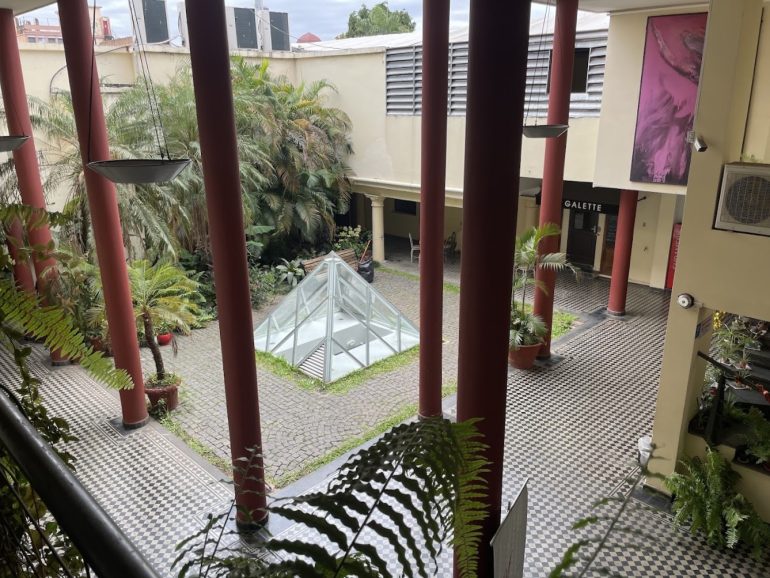

The Alianza Francesa de Asunción and CIF Paraguay will host a new session of their Contemporary French Philosophy Conference Cycle on Thursday, 27 August 2026. The event will explore the body, time and technology through the work of two influential French philosophers. The free conference will begin at 19:00 at the Alianza Francesa de Asunción, located at Mcal. Estigarribia 1039.
The evening will bring together researchers and philosophy enthusiasts for discussions connecting classic philosophical ideas with contemporary questions about technology and human experience.
Rethinking the body through Merleau-Ponty
Hispano-French researcher Christian Blanco will present “El problema del cuerpo en Merleau-Ponty” (The problem of the body in Merleau-Ponty). Blanco is a predoctoral Philosophy researcher at the Université de Liège in Belgium. His academic background includes degrees in Art History and Philosophy, alongside a master’s degree in Philosophy of Science. He has studied in several European countries, including at the École Normale Supérieure in Paris. His research interests include Austrian philosophy, phenomenology and contemporary philosophy.
The work of Maurice Merleau-Ponty (1908–1961) is particularly relevant to questions about how people experience the world through their bodies. A leading figure in French phenomenology, he challenged the idea that the mind and body can be understood as entirely separate. This perspective can also open questions about modern technology. Phones, screens and other digital devices increasingly mediate how people see, communicate and interact with their surroundings. The conference will consider the philosophical problem of the body through Merleau-Ponty’s thought.
Bergson, time and technological life
The second presentation, “Bergson, tiempo y subjetividad tecnológica” (Bergson, time and technological subjectivity), will be delivered by Paraguayan philosopher Jorge Manuel Benítez Martínez. He holds a degree in Philosophy and Educational Sciences from the Universidad Nacional de Asunción. Benítez Martínez also has a master’s degree in Philosophy of History and a PhD in Philosophy from the Universidad Autónoma de Madrid. He teaches Epistemology, Aesthetics and Theory of Knowledge at different academic institutions, including the Universidad Nacional de Asunción and the Instituto Nacional de Educación Superior.
His presentation will focus on Henri Bergson, whose philosophy distinguished between measured time and the subjective experience of time. His concept of durée, or duration, describes time as something continuously experienced rather than simply divided into identical units. This idea offers a contemporary way to consider how technology affects daily life. Notifications, instant messages and constantly changing digital content have transformed how people experience waiting, attention and the passage of time.
French philosophy: Between past and present
Although the presentations focus on different philosophers, both address fundamental questions about human experience. The body, perception, consciousness and time remain relevant as technology increasingly shapes everyday life. The event therefore offers an opportunity to approach French philosophy through questions that extend beyond academia. How does technology affect our relationship with our bodies? Does digital life change our perception of time? And how much of our experience is shaped by the tools through which we interact with the world?
The conference will take place on 27 August 2026 at 19:00 at the Alianza Francesa de Asunción. Admission is free and open to the public. The event is part of a six-session monthly cycle running from April to September 2026, organised by CIF Paraguay with the Alianza Francesa. Previous sessions have addressed thinkers including Frantz Fanon, Henri Lefebvre, Monique Wittig, Bernard Stiegler, Lucien Goldmann, Althusser, Sartre and Camus.
Also read: Watch 10 Free Films With The 17th European Cinema Cycle In Asunción