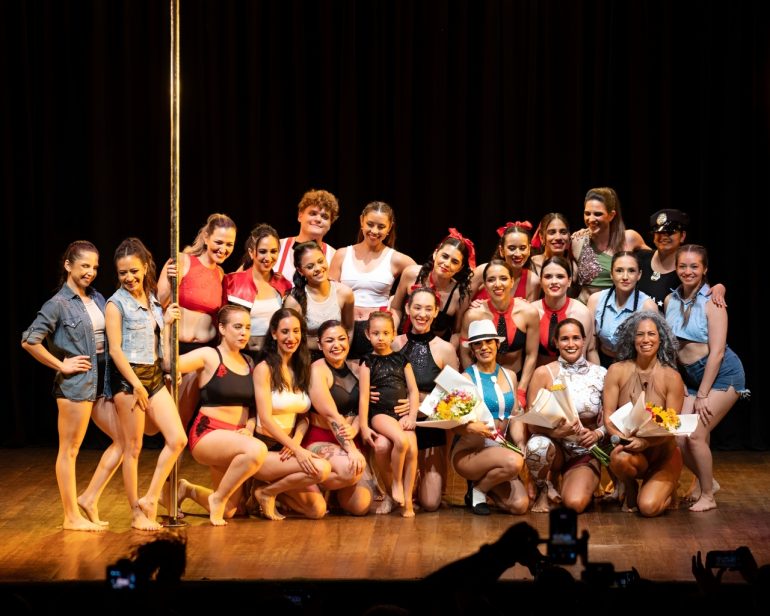

Pole dance in Paraguay has grown from a niche activity into an increasingly established fitness and artistic discipline in the country. According to Mari Moreno, 43, a Honduran instructor at Asunpole, the pole dance community has expanded significantly since the discipline arrived more than 10 years ago. Moreno, who won first place at Exotic Sunday Paraguay 2026 alongside her partner Paola Aguilera, has witnessed much of that transformation. She describes the first five years as “a seedbed and an investigation.”
“Many practised out of curiosity and then stayed because of the results,” Moreno says to The Asunción Times. Word of mouth and visible physical changes attracted new participants, while competitions gradually created another source of motivation. Over the past five years, the growth has become particularly rapid. As more people became interested in competing, “there was more and more interest in participating, which has generated more supply”.
More than an erotic dance
Perhaps the biggest change has been how Paraguayans perceive pole dance. Moreno believes the pole dance community has spent years challenging the idea that pole is exclusively an erotic form of entertainment. “There has been a great deal of work in Paraguay throughout these +10 years to spread pole dance and show its different facets. The general public can now understand that it is not only an erotic dance.”
Today, the discipline brings together elements of fitness, dance and performance. Moreno describes the community around academies such as Asunpole as “people who like this combination of fitness, dance and interpretation”.
“Social media is currently key for promoting any business,” Moreno says, making it an increasingly valuable tool for academies and athletes seeking to showcase their work. The people taking part are equally diverse. “There are no limits in pole dancing, from girls aged four to women aged 60”.
Women currently make up the majority of practitioners, but men are also increasingly visible. Moreno notes that some “perform spectacularly”, challenging assumptions about who can participate in the discipline.
Fitness, art and community
There is not one single reason why people begin pole dance. For some, it offers a different way to exercise. Others are interested in combining dance with fitness, while some discover an emotional benefit. “I would say all of them are!” Moreno says when asked whether fitness, art, emotional wellbeing or community are the main motivations.
“Each person comes for different reasons,” she explains. Some want to exercise differently, while others may seek “a different activity to get out of depression”. Regardless of the initial motivation, Moreno says the outcome is often similar: “More desire to keep doing it and improving.”
Competitions have helped reinforce that motivation. According to Moreno, they provide athletes with a reason to train consistently and “maintain the discipline”. Paraguay currently has two major competitions: Exotic Sunday and Pole Art PY. Until 2025, the country also hosted the Paraguay Pole Championship, the first competition of its kind in Paraguay.
Paraguay’s place in Latin America
Competing internationally, however, requires considerably more than talent. “Pole dance competitions involve a lot of determination, daily training, discipline, consistency and money.”
Paraguay remains one of the younger scenes in Latin America, with countries such as Brazil, Chile, Argentina and Venezuela having longer-established pole communities. Nevertheless, Paraguay is increasingly connected to the regional scene. Workshops, annual school showcases and collaborations between academies provide opportunities for practitioners to exchange skills and build relationships.
Moreno is optimistic about what comes next. Asked how she imagines Paraguay’s pole community in the coming years, her answer is simple: “Each time, bigger and with a very good level.”
From those first curious students to athletes competing on national and international stages, Paraguay’s pole community is steadily finding its place in the country’s fitness and performing arts landscape.