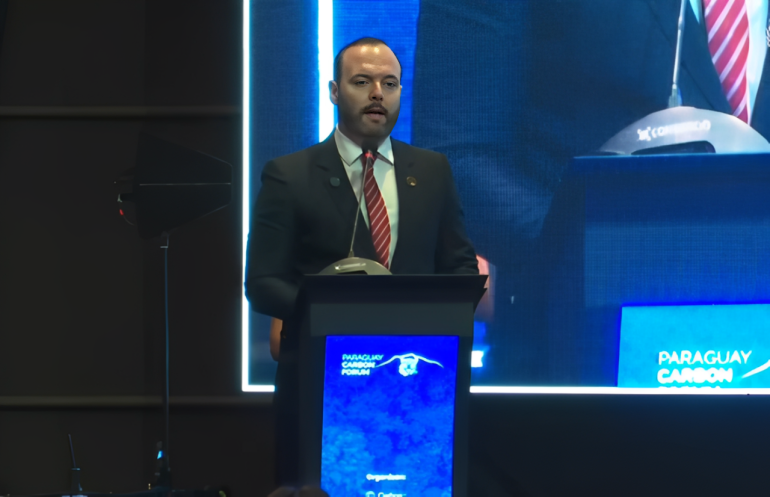

At the inaugural session of the first edition of the Paraguay Carbon Forum, the country’s Minister of the Environment, Rolando de Barros, stated that Paraguay is building a carbon economy. A carbon economy is a system where countries and companies earn money by generating and selling carbon credits from reducing emissions, protecting forests, or capturing carbon.
Paraguay aims to build one by using its forests and ecosystems to sell high-quality carbon credits, attract green investment, and grow a sustainable economy. At the Paraguay Carbon Forum, national authorities outlined the country’s strategy to position itself within the global climate agenda.
The event is considered one of the most relevant regional spaces on carbon markets. Furthermore, it brought together public and private sector actors to discuss opportunities linked to carbon credits, green investments and sustainable development. Officials stressed that Paraguay is entering a key phase in transforming its natural capital into economic value.
Becoming a regional carbon hub as a national strategy
The Minister of Environment, Rolando de Barros, stated that Paraguay is building an economic model to become a regional carbon hub. This model connects biodiversity, production and competitiveness.
“We are building a carbon economy that integrates biodiversity, production and competitiveness within a framework that will allow us to achieve better prices. However, this is not just romanticism. This is a business opportunity that will benefit all sectors of society,” he said.
He also emphasised that the country has moved from discussion to action. Recently, Paraguay established its first Chamber to develop the national carbon credit market. “We have been talking about carbon credits for 20 years. Today it is a reality. Paraguay has already completed transactions and now we are working to double their value.”
According to the minister, the forum is not only a technical event, but a platform to connect natural resources with investment, technology and real market opportunities.
Paraguay as a regional carbon hub
Authorities highlighted Paraguay’s ambition to become a regional carbon hub for international markets. Rolando de Barros noted that the country is positioning itself to attract new activities and generate socio-economic impacts. “Paraguay is already in motion, and what is at stake is the country’s position in the global economy in the coming years. We have decided to lead this process and leave a lasting mark” he stated.
The strategy focuses on leveraging the country’s natural wealth. While also maintaining a balance between conservation and economic growth.
Government vision for green development
President Santiago Peña also reinforced this vision by highlighting Paraguay’s comparative advantages in a world increasingly focused on decarbonisation. “Paraguay offers the world abundant, competitive energy with one of the lowest carbon footprints on the planet. This positions us in a privileged way to attract green industries, hydrogen projects, data centres and companies with rigorous ESG criteria,” he said.
He added that the country’s natural resources and low emissions profile make it a strategic partner in global climate efforts. “Paraguay is a natural ally in a world that demands increasing decarbonisation.” The president also pointed to concrete steps already taken to position Paraguay in international carbon markets. Agreements with countries such as Singapore, the United Arab Emirates and Taiwan were cited as examples of this approach.
“Our commitment is firm: a prosperous, sustainable Paraguay and a protagonist in the new global green economy,” Santiago Peña stated. He stressed that the carbon market should serve as a tool for inclusive development. “We want the green economy to be inclusive, so that its benefits reach people and transform lives.”