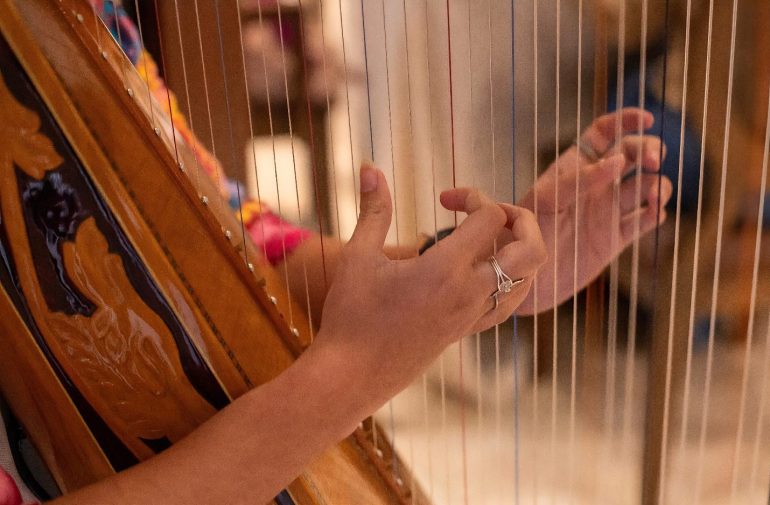

At most international airports, sound is functional. Boarding calls echo through terminals, suitcase wheels rattle across polished floors, and digital announcements compete with the hum of movement. At Silvio Pettirossi International Airport, however, there is another sound. part of what makes Paraguay’s airport sounds so unique. It does not instruct, warn, or direct. The sound invites people to pause. In the middle of the terminal, a Paraguayan harp is played live by professional musician Belén Vera Fleitas, transforming what is usually a place of haste into an unexpected cultural encounter.
A musician shaped by tradition
Belén did not come to the harp through formal planning. Born into a family of musicians, she grew up surrounded by rehearsals, instruments, and melodies woven into daily life. Yet she describes to The Asunción Times her relationship with the Paraguayan harp not as a choice, but as a calling.
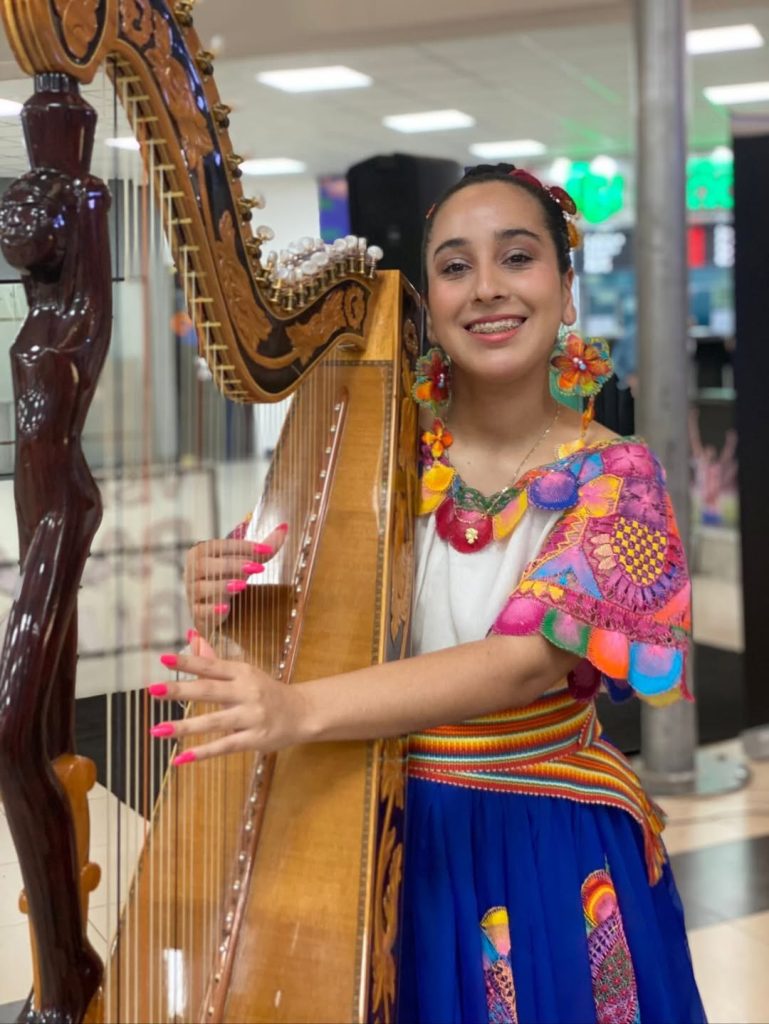
“I was nine years old when I began. From the first moment I saw and heard it, I felt something very deep. It was never just an instrument; it became a way of expressing what I feel.”
That emotional connection now resonates far beyond the practice room. The harp’s sound is heard by thousands of passengers every week, many of whom had not expected to encounter live traditional music between check-in counters and duty-free shops.
Paraguay’s Airport sounds resonate
The idea of placing a delicate acoustic instrument inside an airport might seem contradictory. Airports are defined by speed, technology, and logistics, yet her first day quickly revealed that the harp did not disappear into the background noise. Instead, it altered it.
“At first, I thought the instrument might be too fragile for such a dynamic environment. But the opposite happened. The sound slowed things down, even if only for a few seconds.”
Travellers rushing to the gates glance up. Some reduce their pace. Others stop entirely, momentarily unsure why they have done so. In a setting engineered for movement, Paraguay’s airport sounds create stillness.
The emotional geography of travel
Airports are not merely infrastructure; they are emotional crossroads. Departures, reunions, migration, holidays, and long-awaited returns all intersect in the same physical space. Belén has learned to read this emotional landscape without words.
“There are people travelling lightly, excited to see someone again. Others carry heavier silences. When I sense nostalgia, I choose softer, more intimate pieces. When there is joy, I play livelier polkas. The music should converse with the moment.”
This responsiveness turns each performance into something situational rather than staged. There is no formal concert hall, no programme notes, and no fixed audience. Yet the interaction between musician and traveller is immediate and deeply personal.
A country’s farewell, heard in music
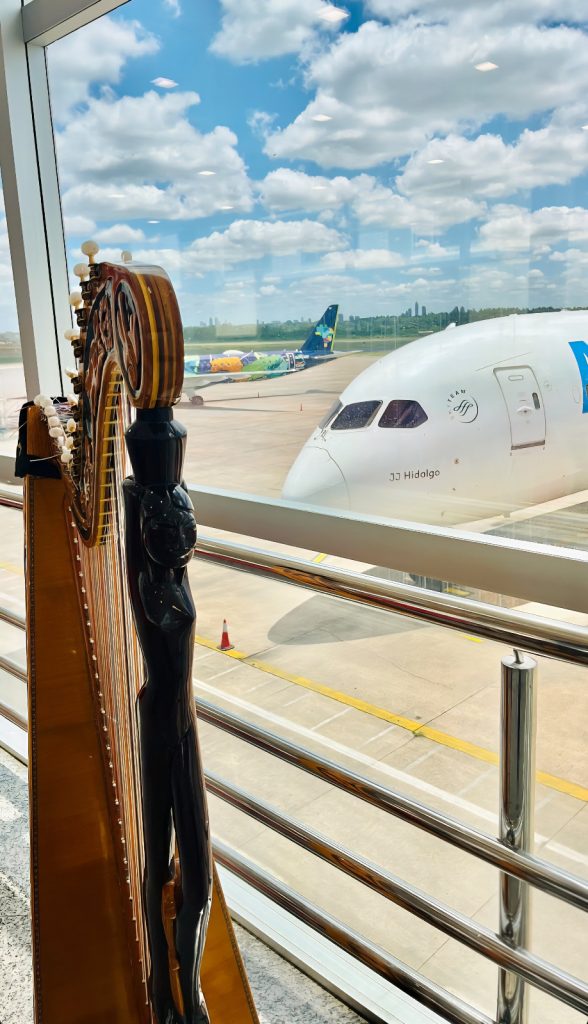
For many international visitors, Belén’s performance becomes the final sensory memory of Paraguay before departure. Just metres away from departure gates, the harp offers what might be described as an acoustic goodbye. And she knows it.
“The Paraguayan harp is one of our strongest cultural symbols. Knowing that it can be the last sound someone hears before leaving fills me with pride and responsibility.” Unlike recorded music or background playlists common in transport hubs, the live performance conveys presence, an authenticity that cannot be automated. Each note is produced in real time, in the same space where travellers prepare to cross continents.
Although passengers come from diverse linguistic and cultural backgrounds, certain melodies generate universal attention. Traditional pieces such as Recuerdos de Ypacaraí, Pájaro Campana, and Galopera regularly draw listeners closer, even when they do not recognise the titles. “The Paraguayan polka has an energy that crosses borders. It is rhythm before translation.”
This universality is key to the project’s success. The music does not require explanation panels or curated exhibitions; it communicates instantly, allowing culture to be experienced rather than interpreted.
Cultural diplomacy without formalities
While no official speeches accompany her performances, Belén’s role has gradually taken on a diplomatic dimension. Each day, she represents Paraguayan heritage to an international audience without ceremony or protocol. “Even though I am alone with my instrument, I feel that I represent part of Paraguay’s cultural soul. Each interpretation is like a small musical embassy.”
This informal cultural diplomacy distinguishes the airport from others around the world, where art installations are often static or decorative. Here, culture is not displayed, it is performed, lived, and heard. Creating a sense of serenity in an open, noisy environment demands discipline. Announcements, conversations, and constant movement require intense concentration to maintain artistic quality. “The hardest part is consistency. You must sustain a high artistic level while everything around you is in motion. And emotionally, you witness many intense farewells every day.”
Redefining what airport sounds can be
Globally, airports increasingly compete to offer memorable passenger experiences through architecture, retail, and technology. Paraguay’s approach is strikingly different: instead of spectacle, it offers intimacy. By employing a professional harpist rooted in national tradition, the country has turned a logistical hub into a cultural threshold: a place where identity is heard as well as seen.
In an age defined by acceleration, the presence of live harp music inside Silvio Pettirossi International Airport suggests another possibility for travel: that even in transit, there can be time to listen. And then, having listened, to continue the journey.
To know more about the harpist at the airport, follow Belén Vera Fleitas on Instagram.