
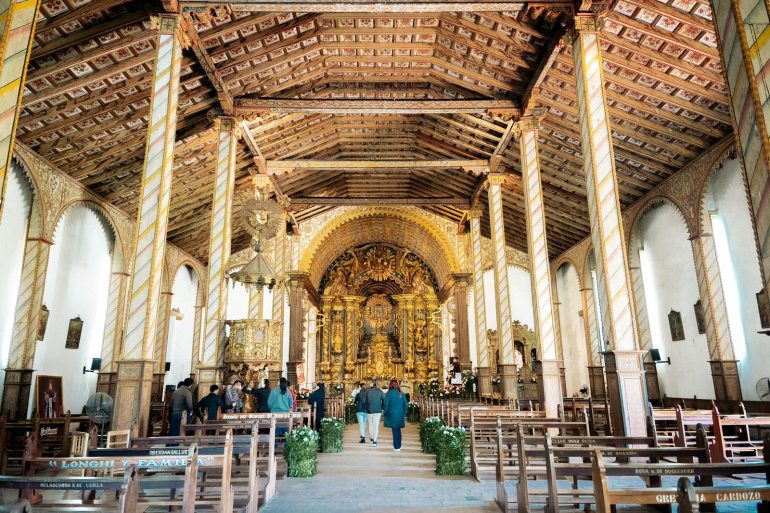

This story is the winner of the Editor’s Choice Award in The Asunción Times Writing Competition 2025. Read about Saint Buenaventura Temple, the unique baroque treasure of Paraguay through the eyes of Paraguayan Violeta Castellani.
A dreamlike sanctuary
This place feels far away from daily life for those of us dwelling in Asunción. I chose it for being a unique gem with an unimaginable historical and cultural value that has survived through centuries. I am talking about Saint Buenaventura Temple, better known as ‘Iglesia de Yaguarón’, a dreamlike sanctuary deeply marked by time with flying angels, and holy saints surrounded by a golden glow.
Forty-eight kilometres away from Asunción, in the Paraguarí department, we find one of the country ‘s most important cultural, historical and touristic landmarks. According to the poetess and playwright, Josefina Plá, the structure’s original foundations were placed over an indigenous settlement, which was taken over by colonisers to relocate their people in the middle of the 18th century. Unfortunately, for several years they could not flourish because of violent Payagua’s incursions, until the governor Don Rafael de la Moneda managed to stop them.
People at the time were in a frenzy for building and the Franciscans wanted to display their skills. They wanted a vaulted church, but since they could not afford the high prices of imported materials, they adapted local resources to create it without giving up the luxurious interior they envisioned, even though they had no specialised artisans.
A massive challenge
Going through the massive challenge, they choose José de Souza Cavadas as the architect in charge of the ambitious construction. It is important to mention that this is not his only work, he also participated in the Capiatá and Piribebuys’ Sanctuaries projects, as they show a similar aesthetic style.
But what sets the Yaguarón church apart from the others is the magnitude of its art. It has an overpowering amount of ornaments that overflow the senses and allow its guests to discover something new in every visit. And between burning incense, old wood essence and a tinge of dampness that oozes from adobe walls a space of peace and deep reflection is created for those who come to profess their faith.
A misleading touch of simplicity
In a country far away from the baroque and in an era that favors simplicity and minimalism Saint Buenaventura Temple has a special charm: on the outside its calcarean white walls shine above the green grass while its rustic bell tower -a few meters away- gives it a misleading touch of simplicity. But once you step inside, the interior amazes and captivates at first sight.
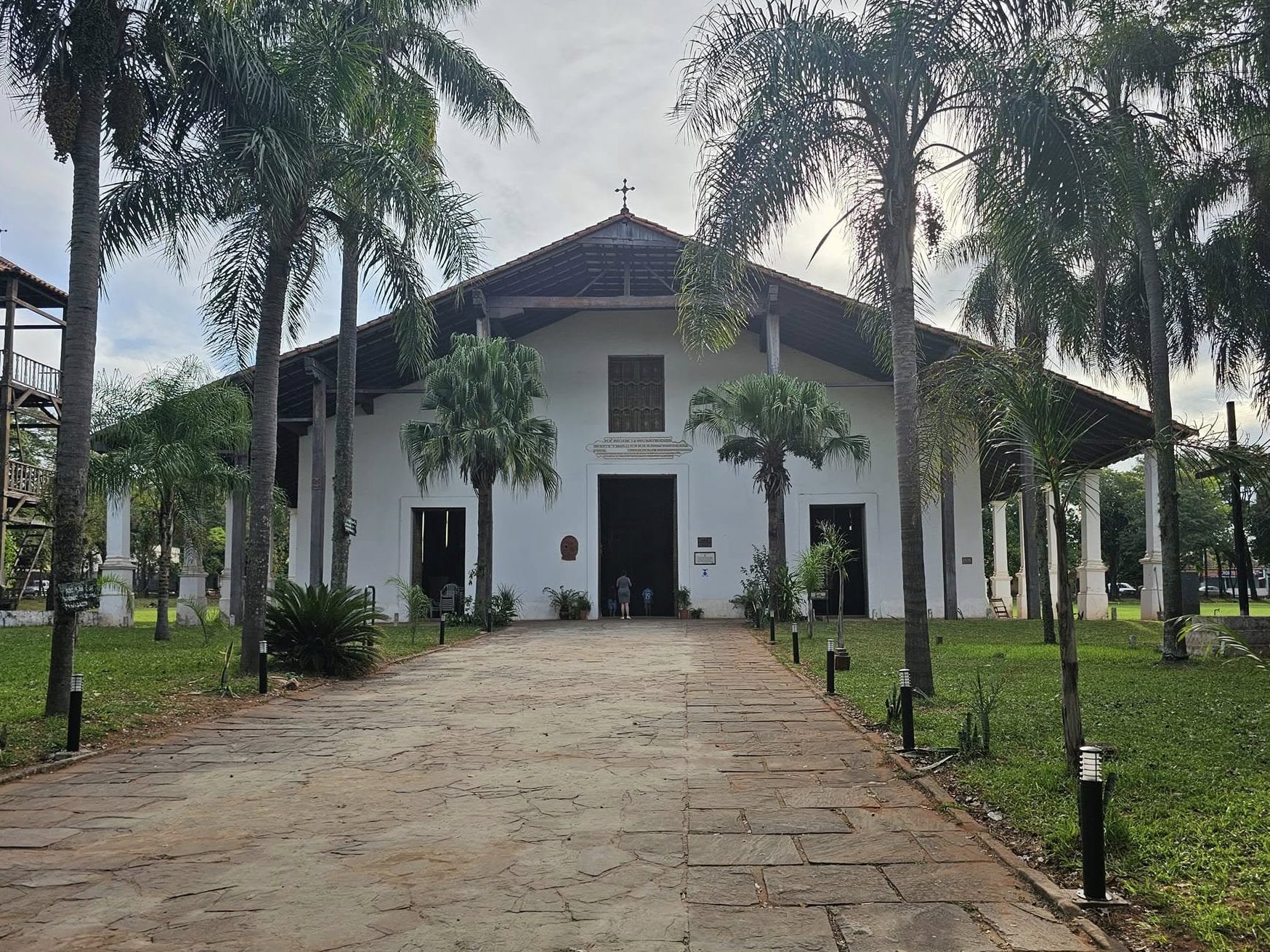
With its hallowed and immutable air, it is a spot that brings me back to my childhood. I have fond memories of visiting with my family as part of the Holy Week custom of going to seven churches on the same day, also known as the siete iglesias tradition. In particular, in 2015, when one of my foreign friends visited Paraguay for the first time, my father took us on a tour, and we went to the sanctuary, unaware that it would be the last year I could enjoy the visit with him before his passing.
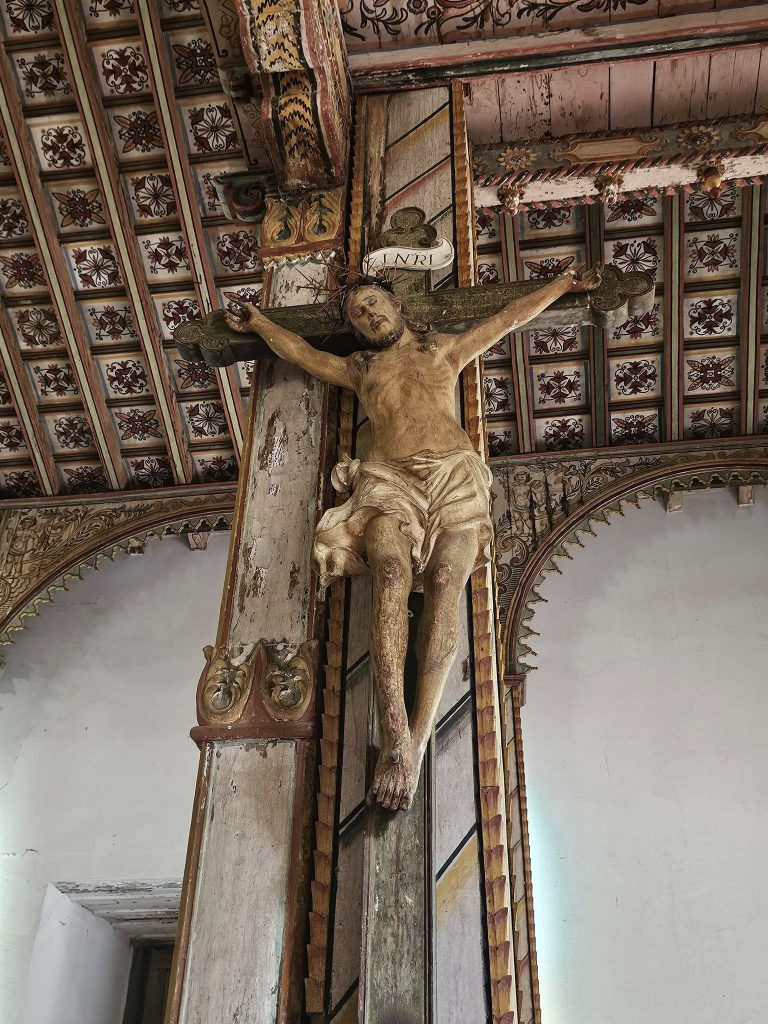
With its humble front, the Yaguarón structure has twenty-one columns placed in each lateral corridor of its fascinating interior, creating a whirlpool of colors that send the imagination on a journey to the past with holy mourning virgins and a crucified Jesus above, turning the experience into a vivid treasure to this day.
Inside Saint Buenaventura Temple
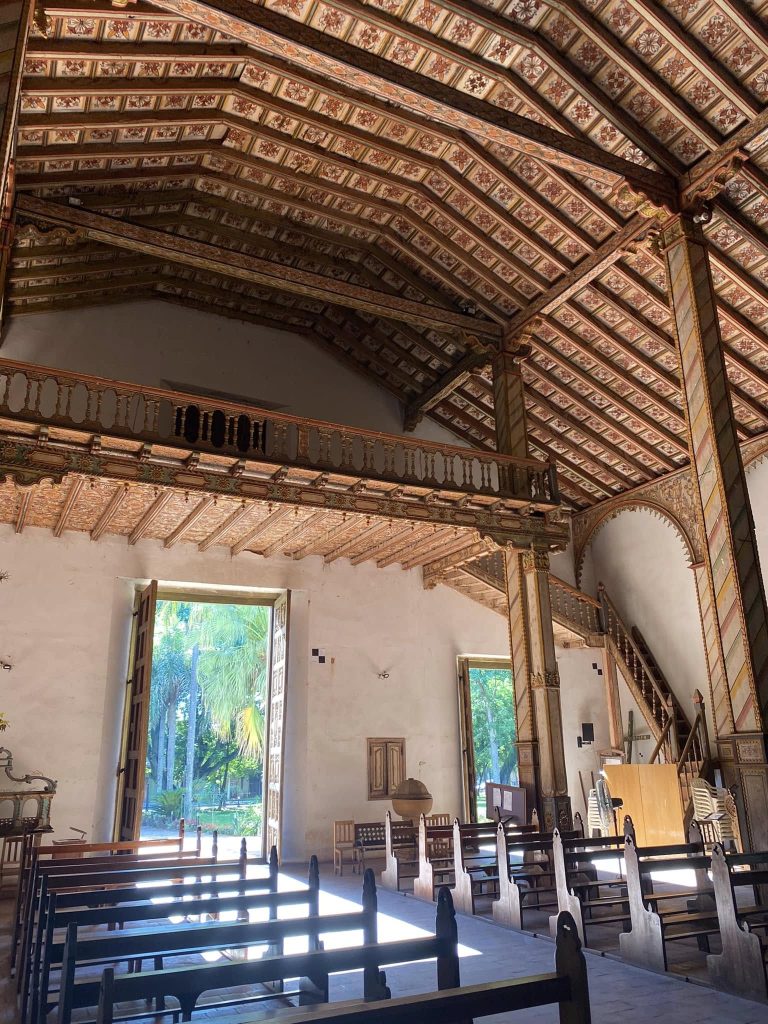
In every visit, people are received by its two carved doors, adorned with geometric and floral details. After passing through the gateway, your eyes can travel from the painted roof, featuring local flora, down to the central corridor, where white columns with red, green, and yellow spiral stripes support the roof beams.
Once inside, the visual spectacle does not end there. One cannot help but be captivated by a delicate wood carving of a young man with his hands raised towards the heavens, holding the hexagonal pulpit above him. There are flying angels sculpted on each side, inviting you to pay attention to the priest’s sermon during the religious services.
A fourteen-meter-high altarpiece
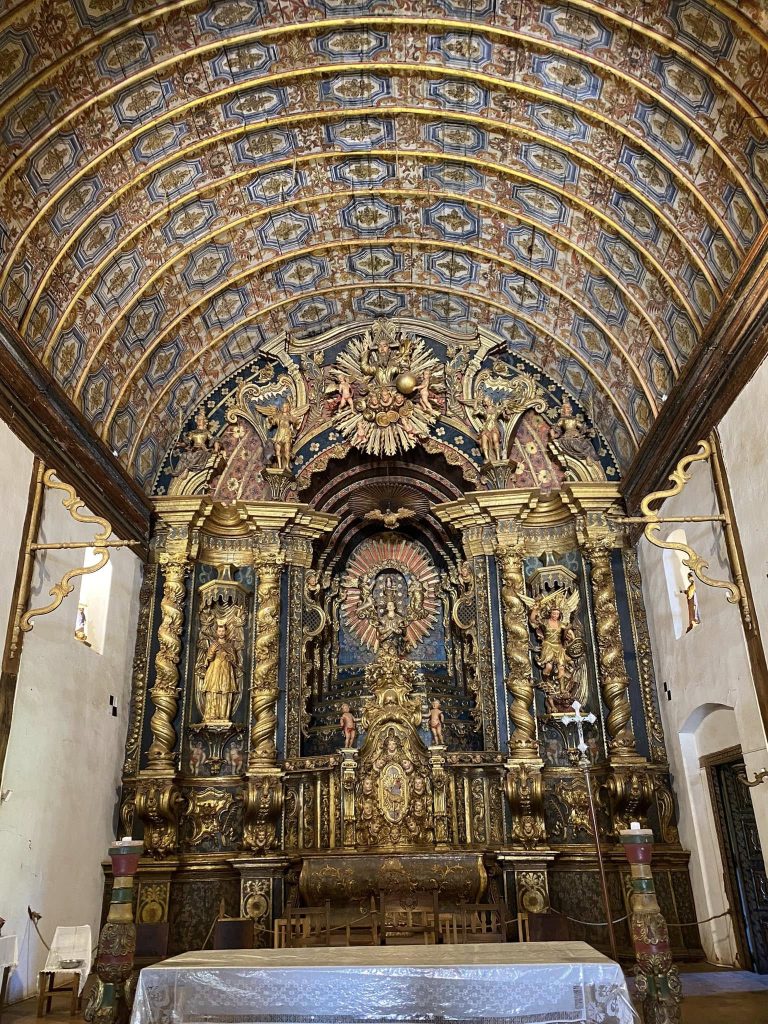
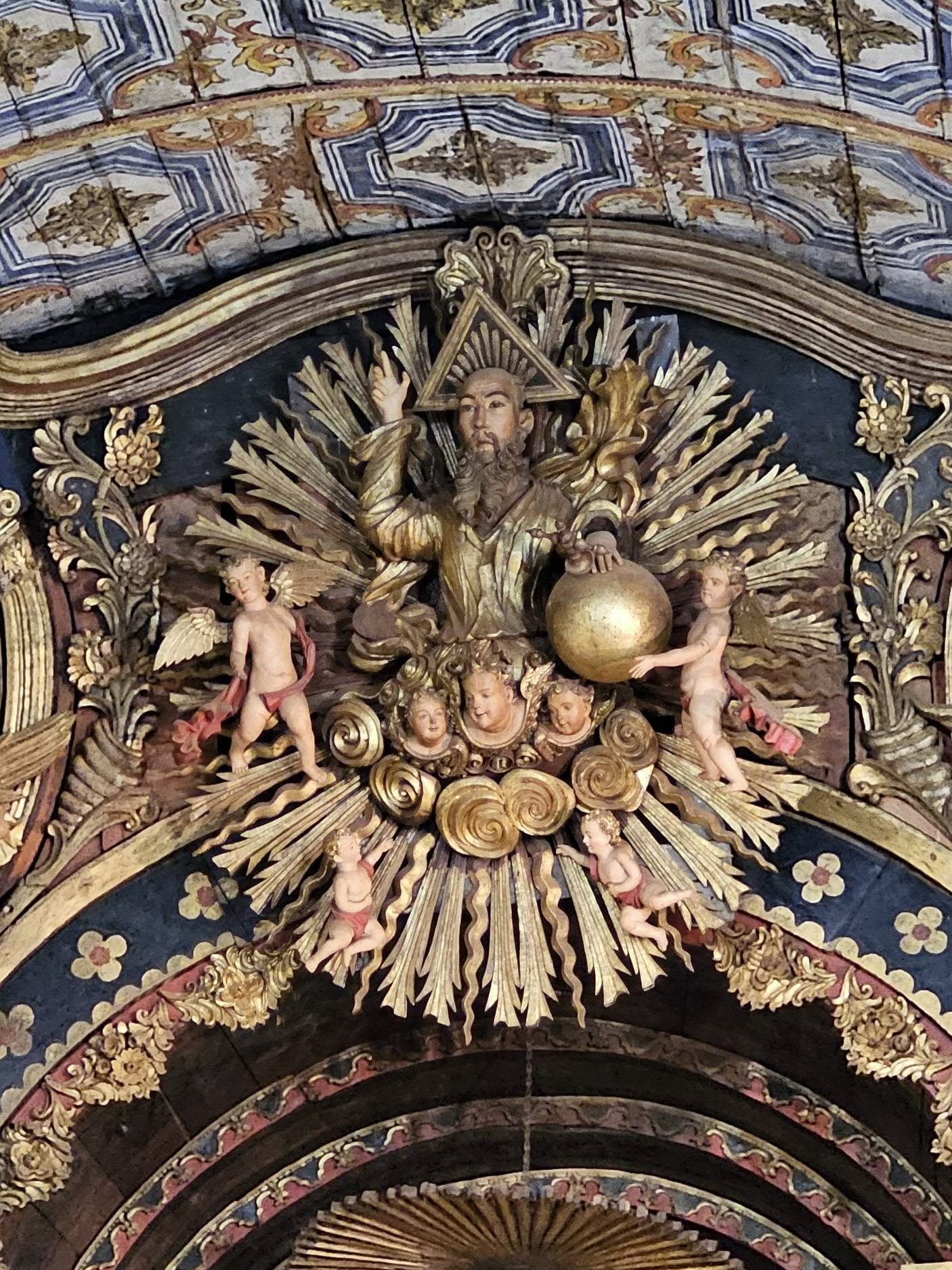
But the highlight is the presbytery where an imposing fourteen-meter-high altarpiece crowns the main altar challenging the eyes. At its highest part, an image of Father God can be seen among halos of light, flying cherubs, flowers, and gilded decorations. The effect is visually overwhelming, guiding the gaze to the Divine Conception, surrounded by the Holy Spirit under the glow of its wings, all crafted by hand in deep and exquisite carvings.
On both sides, columns embellished with iridescent ochre ferns, passionflowers and palms frame the statues of Saint Buenaventura and the Archangel Michael defeating the devil at his feet. And at the lowest point, ten cherubim surround a representation of the sacrificial lamb, symbolising Jesus.
Silently observing the sacristy
Another lovely area inside the temple is the sacristy. It is currently undergoing restoration, but I can still remember the false wooden dome that rested atop the arms of adorable cherubims, also decorated with golden reliefs. The last time I saw it before the renovations, I silently observed the sacristy out of respect for the crucified Jesus, placed in the center of the gold, silver, and red columns, while tiny, stealthy bats hid between the carvings, trying to sleep away from the daylight.
It is important to mention that Saint Buenaventura Church, as a three-century-old building, has long been in need of further renovations to combat the inevitable wear and tear of time. Fortunately, under the current administration, the president recently announced the start of new restorations, aiming to preserve the sanctuary’s unique cultural value for future generations. This will be achieved thanks to the intervention of the Teko-renda Program of the National Cultural Secretary, with the support of Itaipú.
This is great news that not only brings happiness to Yaguarón citizens but also to everyone in our country. As a majestic place to which no photo has been able to do justice, there is no doubt it deserves the love of Paraguayans and the utmost respect for all those who built, decorated, and maintained this historic structure. The Saint Buenaventura stands as a living witness to the encounter between the ancient New World, and the Paraguay we know today.
A connection to religion and history
Also, as a Paraguayan, this sacred site helps me to be more introspective of my cultural identity; connecting me with the religion and the history of my country. When I am there, I deeply love escaping everyday life and surrounding myself with baroque art, admiring its magnificence that has transcended time, and feeling proud of this invaluable heritage.
Saint Buenaventura Temple is my personal sanctuary, representing the persistence of our memory. Its legacy revolves around beauty, history, and religion, connecting us with our beliefs and emotions, and moving us to our core. It teaches us to appreciate art and the extent to which the deepest human dedication and religious devotion can create.
Read more about Saint Buenaventura Temple on the UNESCO website.

