


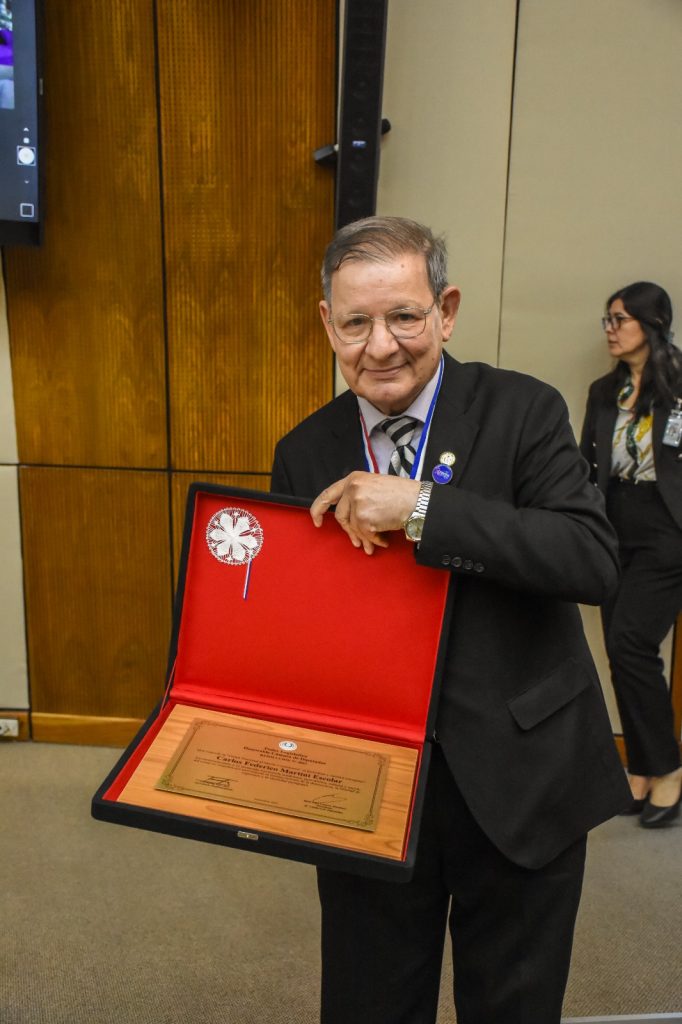
Amnesty International Paraguay recently recognised the famous Paraguayan journalist Carlos Martini (67) with the Peter Benenson 2025 Award in the ‘Traditional Media’ category. This is an annual human rights award named after the British lawyer who founded Amnesty International in 1961. The award recognises individuals or organisations for outstanding efforts in defending human rights, serving as acknowledgment for their work.
Carlos Martini is a journalist of enormous trajectory, an indisputable reference, and one of the most beloved communicators in Paraguay. He focuses on human stories with calm professionalism, avoiding sensationalism. Martini speaks with The Asunción Times, presenting himself in his most honest public version.
“A volcano in eruption on the inside”

Carlos Martini’s public style is calm, sober, and measured. Yet he insists that this composure is not natural. “I am a volcano in eruption on the inside,” he says.
Martini currently hosts the popular Primera Edición programme on Channel 13 from Mondays to Fridays at midday, and leads the radio programme ‘Martini 680’ on 680 AM. There, he shares his reflections, book recommendations, and interviews, highlighting his career as a communicator and his past as an aspiring Jesuit priest.
Martini has also taught for over twenty years at the Catholic University of Asunción, where he served as Director of Social Sciences and Academic Director. Despite his media presence, he resists identification with television. “I am on television, but I am not of television.”
Earlier in 2025, the Chamber of Deputies awarded him the National Order of Comuneros Merit. His response was measured and consistent with his thinking: “Of course, education must be of high quality, teachers need to stay up to date, and more investment is required; but beyond that, education must give us a sense of purpose in life.”
Empathy as a method of survival
Martini’s calm delivery often surprises audiences, given the intensity of his convictions. He explains this as a necessity rather than a virtue. “To coexist, one needs empathy. Without empathy, there is no possible coexistence between human beings.”
Empathy, for him, requires tolerance and openness. “To be tolerant, you must accept other ideas.” This often demands restraint. When faced with injustice, anger is immediate. Control is a choice.
He recalls a moment that tested this discipline. “When I learned that hospital patients were being given cocido negro for breakfast, my first reaction was rage.” Many would shout or insult. He chose otherwise. “I decided to be calm, but very firm.”
The dictatorship as a moral boundary
Martini’s ethical stance was forged early. In January 1976, his school, Cristo Rey, was intervened by Paraguay’s then dictatorship. “That day, my world collapsed.” He was detained and learned what power without limits looks like.
“That experience taught me what should never be done. My intransigence, if I have one, is against any authoritarian regime. Of any sign.” This position has never shifted. He rejects political absolutism and ideological fanaticism alike.
The deepest forms of legacy from Carlos Martini
Martini describes television as unforgiving. “It is implacable. It reveals everything.” This exposure taught him restraint. “Television taught me self-control.” Radio, he adds, allows greater intimacy. Television demands discipline.
Despite decades on screen, he resists celebrity logic. Visibility, for him, is accidental. Responsibility is not. Despite decades in the media, Martini rejects the idea of public recognition.
“When I die, I do not want to be remembered as a journalist. Nor as a writer. I want to be remembered as a teacher.”
For him, teaching leaves invisible marks. “The professor leaves traces,” he explains, quoting Octavio Paz’s expression huellas del alma. Martini believes education transcends time. “You reach the students, then the children of your students.”
He insists that his connection with the public did not come through print or radio, but through television. “It was in the second or third year at Channel 13 that people began calling.” At that moment, he faced a choice. “Do I betray who I was?” His answer was no. “I translated the academic world into the media.”
Why young people listen
Martini remains puzzled by his popularity among young audiences. “I am hyper-formal. A solitary. I am not spontaneous.” He insists he lacks social charm. “I am everything but likeable.”
Yet young people listen. Martini understands the responsibility this implies. “With adults, you can be flexible. With young people, you cannot. They are still forming themselves. If you tell them a lie, and they believe you, you are transmitting falsehoods.”
He believes young people need mirrors. “They need figures they trust.” If he serves that role, his duty is clear. “I must transmit honesty, tolerance, and a sense of justice.”
Being viral without wanting to be
Martini is often turned into social media trends. He remains indifferent. “It interests me nothing,” he says bluntly..” He does not measure success through likes or reach.
What he does online is consistent with his work. “I tell stories.” That is why he uses Instagram and Facebook. TikTok, he says, does not allow that depth. He is openly critical of the platform. “TikTok is a monument to human stupidity.”
Listening as resistance
For Martini, journalism begins with listening. He considers it a lost art, and he never interrupts interviewees. He writes notes while they speak. Only when they finish does he respond.
He recalls a Christmas programme with a psychiatrist and a priest. Both agreed on one thing. “We no longer communicate authentically.” Real dialogue, he believes, has been replaced by monologues.
Narcissism and the modern world
Martini sees narcissism as the dominant trait of the era. “We are in love with ourselves.” Social media, he believes, amplifies this tendency. Everyone wants to show their best version, “which is often the most false version.”
He references the myth of Narcissus. “He admired himself. And he drowned.” Ego, he argues, prevents listening. “Everyone believes they are right.” If society continues this way, he predicts constant confrontation. Journalism, for him, must resist shouting and return to listening.
Martini’s story reveals the principles, struggles, and convictions that shape him. In part 2 of this interview, we meet another side of Carlos Martini, and discover the traits that define his life beyond journalism.
This article was written in collaboration with Juanfer, another author from The Asunción Times.

