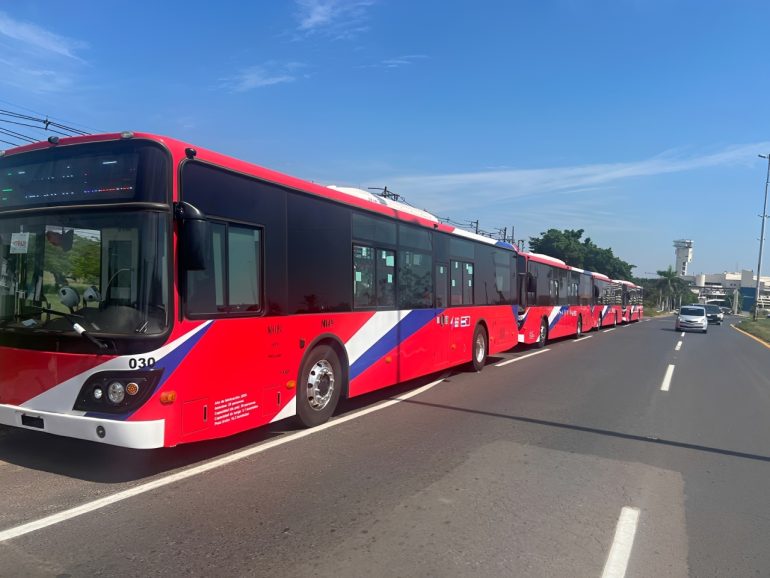

Paraguay has taken another step towards modernising public transport with the launch of the E3 line. This new expansion links the historic centre of Asunción with the country’s main international gateway. The E3 line began operating in the second week of March as part of the government’s broader strategy to introduce cleaner and more efficient mobility in the metropolitan area.
The new E3 line connects the Costanera near the government offices at the Port of Asunción with the Silvio Pettirossi International Airport. This creates a direct transport option between the capital’s administrative district and the airport in Luque. Authorities say the project builds on the experience gained with the previously introduced E1 and E2 electric bus lines.
The E3 line
The new E3 line was introduced by the Ministry of Public Works and Communications (MOPC) through the Viceministry of Transport. It is currently operating in a pre-operational phase. During this stage, drivers are familiarising themselves with the route while technical teams continue making operational adjustments.
Despite being in the preliminary phase, the service is already available for passengers with a reduced schedule. The fare has been set at ₲3,400. This aligns with the standard cost of metropolitan bus services.
Authorities emphasise that the buses operate with fixed and clearly marked stops throughout the route. This system is designed to improve passenger flow and organise boarding and disembarking points. These factors are also designed to increase overall efficiency and travel speed along the corridor.
E3 line details
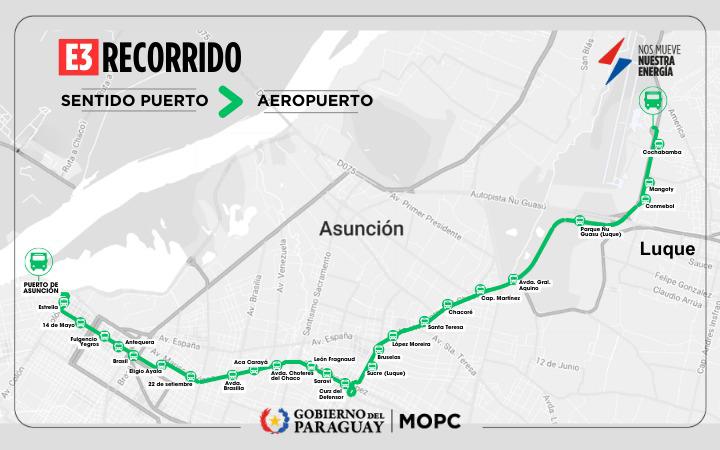
The E3 line begins near the Government Offices complex. It continues through several key streets and avenues in Asunción before heading towards Luque. The buses travel along Colón, Oliva, Cerro Corá, and Perú Avenue before joining Mariscal López and República Argentina avenues. The route then continues through Dr. Eulogio Estigarribia, Cruz del Defensor, and General Bernardo O´Higgins. The streets that follow are Carlos Guido Spano and San Martín Avenue.
From there, the buses proceed along Aviadores del Chaco and Pettirossi avenues until reaching the airport roundabout. On the return journey, they follow the same path backwards. It begins on the airport roundabout, followed by Pettirosi and Aviadores del Chaco avenues before reconnecting with the San Martín and Mariscal López avenues.
Then it continues along Perú Avenue, Azara, José Eduvigis Díaz, and Hernandarias. Lastly, they return to the Government Offices complex near the Port of Asunción.
Building on the success of Paraguay’s first electric bus lines
The introduction of line E3 represents the latest phase in Paraguay’s gradual expansion of electric public transport. The first two electric routes, E1 and E2, were launched earlier as pilot corridors. To test operational logistics, passenger demand, and charging infrastructure.
Those lines marked an important milestone for the country’s transport system, introducing zero-emission vehicles into everyday urban mobility. The buses operate quietly and produce no local air pollution. This helps to reduce environmental impact while offering a more modern travel experience.
With the addition of line E3, authorities aim to strengthen the electric bus network and improve connectivity between key areas of the metropolitan region. These include administrative districts, residential zones, commercial corridors, and the international airport. Officials also note that the expansion demonstrates the government’s intention to gradually scale up electric transport options as part of broader sustainability and urban mobility policies.
Electric buses supported by Paraguayan engineers
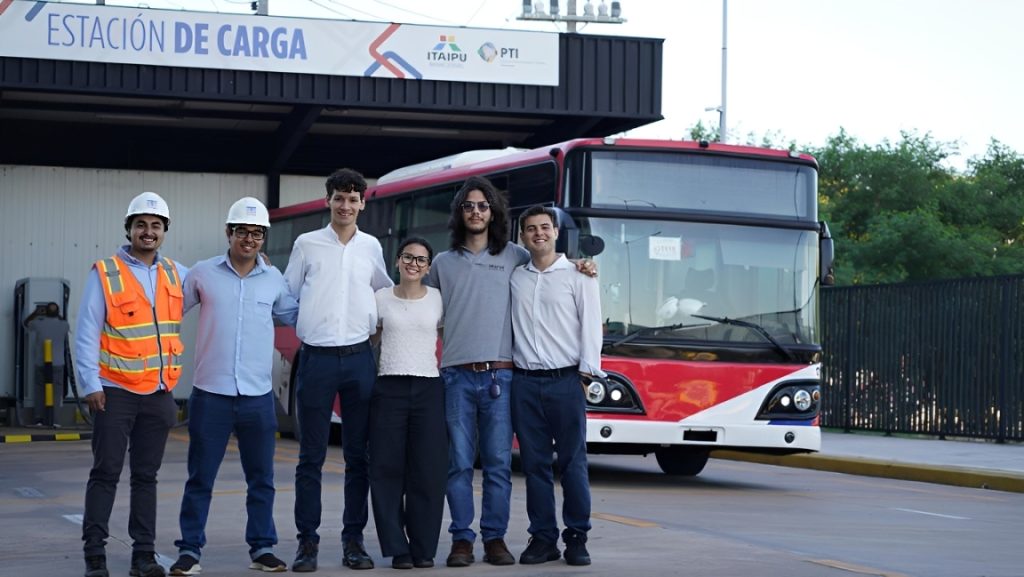
The implementation of Paraguay’s electric bus system, like the E3 line, has also been supported by local engineers trained at the Taiwan-Paraguay Polytechnic University (UPTP). These engineers are contributing technical expertise to the project.
One of them is electromechanical engineer Federico Vera. He works as a technical advisor on electromobility within the Viceministry of Transport. His role involves supporting the implementation of the system and monitoring its operation. Also, in assisting with maintenance strategies for the electric units.
Another professional involved in the project is Bruno Sánchez. Sánchez serves as a technical assistant at the company responsible for manufacturing the electric buses operating in the system. He highlights the opportunity to contribute to a project that combines professional development with national progress.
Engineer Fernando Segovia is also a graduate of the Taiwan-Paraguay Polytechnic University. He participated in the electrical infrastructure works required to support the operation of the buses. Particularly, in relation to charging systems and related installations. According to the engineers, studying there and also abroad allowed them to gain exposure to advanced technologies and mobility models that can now be adapted to Paraguay’s transport sector.
A step forward in Paraguay’s transition to electric mobility
The electric buses currently operating in the metropolitan area were donated by Taiwan. The donation was a part of bilateral cooperation initiatives with the aim of supporting sustainable transport projects in Paraguay. Authorities say the growing network of electric routes represents an important step towards cleaner urban mobility, improved passenger services, and reduced dependence on fossil fuels in the public transport system.
With the addition of the E3 line, the electric bus system now reaches one of the country’s most strategic transport hubs. Offering residents and visitors a new alternative for travelling between the capital and the airport. While also reinforcing Paraguay’s gradual shift towards modern and environmentally friendly public transportation.