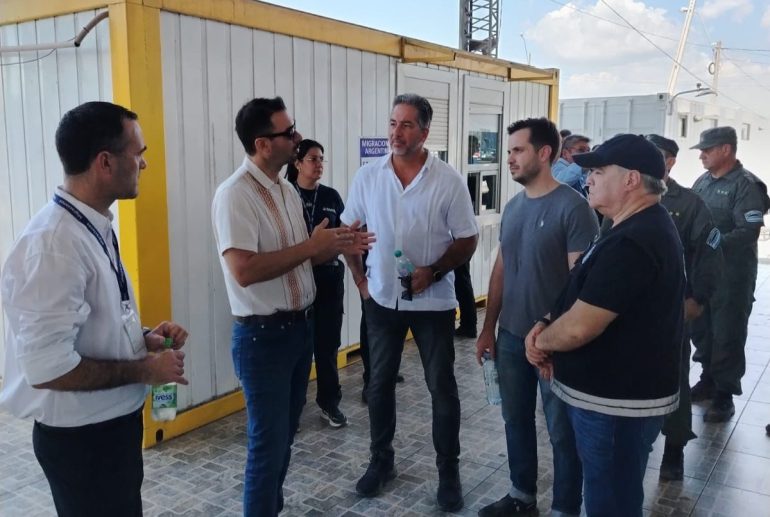

Migration authorities from Paraguay and Argentina have convened at the Puerto Falcón-Clorinda border crossing to finalise the implementation of a new unified binational migration control post. This development in bilateral cooperation aims to streamline transit and enhance security, with a pilot test of the new system kicking off on 9 February, 2026.
Present at the crucial planning session were Jorge Kronawetter, the National Director of Migration for Paraguay, alongside his Argentine counterparts, Martín Ferlauto, the National Secretary of Security, and Sebastián Seoane, the National Director of Migration for Argentina. The officials conducted a thorough on-site verification of the infrastructure and procedures. Following their discussions, they confirmed the upcoming pilot test, marking a critical step towards modernising one of the region’s important transit points.
A new framework for Falcón-Clorinda Crossing
The new system will operate under a framework known as Recognition of Reciprocal Competencies (RRC), or Reconocimiento Recíproco de Competencias in Spanish. This model is designed to unify and integrate information systems between the two nations. Consequently, it creates a single, more robust process for migration control. Instead of travellers undergoing separate checks by both Paraguayan and Argentine officials, the RRC system allows for a single inspection point where the checks performed by one country are recognised as valid by the other.
This cooperative approach is expected to significantly reduce processing times for individuals and vehicles crossing the border. The primary objectives of this initiative are twofold. Firstly, the integration of data will provide a more comprehensive security overview for both countries, allowing for more effective monitoring and control of cross-border movements. Secondly, the project is designed to deliver a major improvement in the fluidity and speed of transit.
Drawing on successful precedents
This initiative at the Falcón-Clorinda crossing is not without precedent. Paraguayan and Argentine authorities are building on the successful implementation of a similar unified control system at the heavily trafficked Encarnación-Posadas border. That project has already demonstrated tangible benefits, including reduced congestion and faster processing times. The lessons learned from the Encarnación-Posadas model have provided a valuable blueprint for the new installation, allowing officials to anticipate challenges and refine the process.
The positive outcomes observed at the Encarnación-Posadas crossing have created strong momentum for extending the unified system, showing a clear commitment to enhancing regional integration.
Implementation and joint supervision
A key feature of the new unified control post is that it will be under the permanent and joint supervision of officials from both Paraguay and Argentina. This continuous collaboration is essential to ensure the system operates smoothly and that any issues are addressed promptly. The presence of personnel from both nations at the single control point guarantees that the standards and legal requirements of each country are met simultaneously.
The pilot test on 9 February will be a critical phase, allowing authorities to evaluate the system’s performance in a live environment. During this trial period, officials will monitor workflows, test the integrated technology, and gather data to make any necessary adjustments before a full-scale launch.