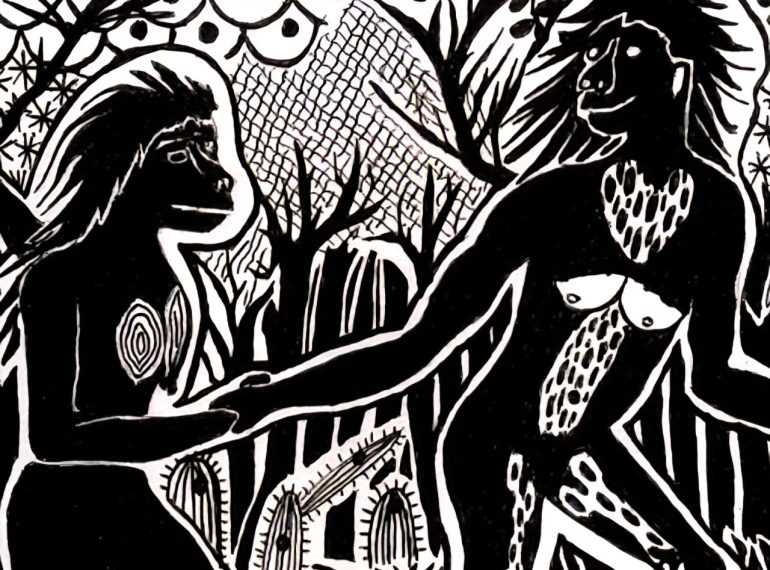

In the sacred tapestry of Guaraní mythology, few stories are as tragic or as foundational as that of Tau and Kerana. Their union, born of obsession and kidnapping, did not just produce a family; it birthed a pantheon of seven monstrous entities that define the supernatural landscape of the Southern Cone. This is a story of divine intervention, cosmic curses, and the ultimate sacrifice of a human heroine.
The sleeping beauty and the evil spirit
The legend begins with Kerana, a human woman of incomparable beauty. The daughter of Marangatu (himself a descendant of the first humans, Rupave and Sypave), she was known throughout the tribe as the “Sleepyhead” because she spent her days in deep, peaceful slumber.
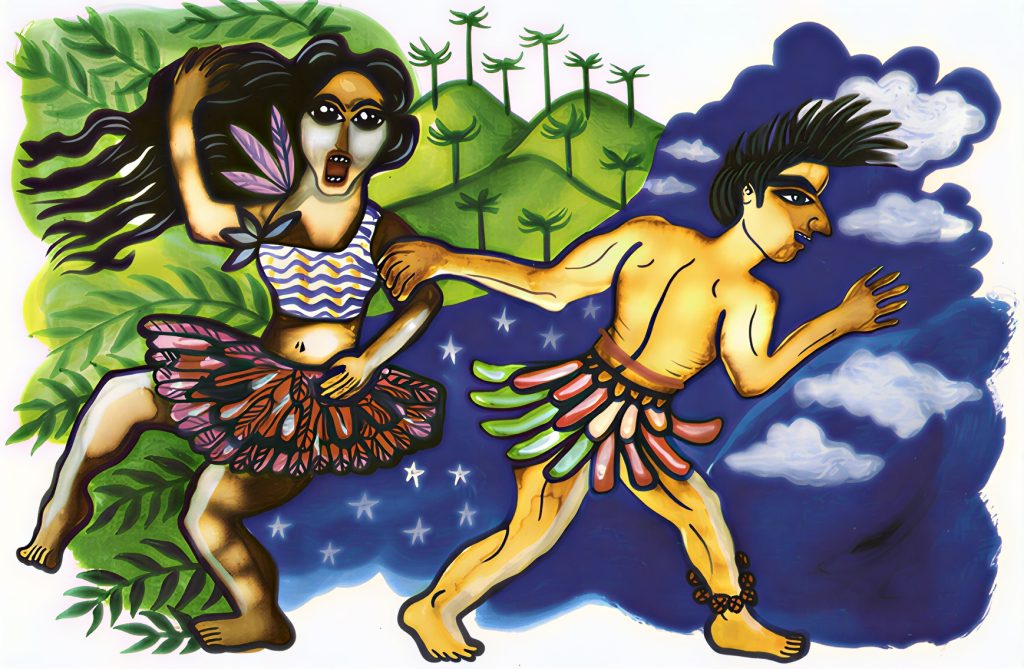
Her beauty caught the eye of Tau, a powerful and malevolent spirit of the night. Desperate to possess her, Tau disguised himself as a handsome, elegant young man to woo her. For seven days, he visited her, using a magical flute to enchant her dreams. However, Angatupyry, the spirit of supreme goodness, saw through the deception.
A titanic battle ensued between Good and Evil. For seven days and nights, Tau and Angatupyry fought for Kerana’s soul. On the final day, Tau invoked the help of Pytajovái (the god of war and destruction) and managed to defeat Angatupry through treachery. He snatched Kerana away, fleeing to a distant hideout to claim her as his wife.
The divine curse: Seven monstrous sons
The tribe, devastated by the abduction of their most beautiful maiden, implored the gods for justice. Arasy, the great goddess and companion of the supreme god Tupã, heard their cries. She did not strike Tau down with lightning; instead, she placed a biological curse upon his bloodline.
Every child born to Tau and Kerana would be a “sietemesino” (born at seven months) and would take the form of a hideous, terrifying beast. These seven brothers became the legendary monsters of the Chaco:
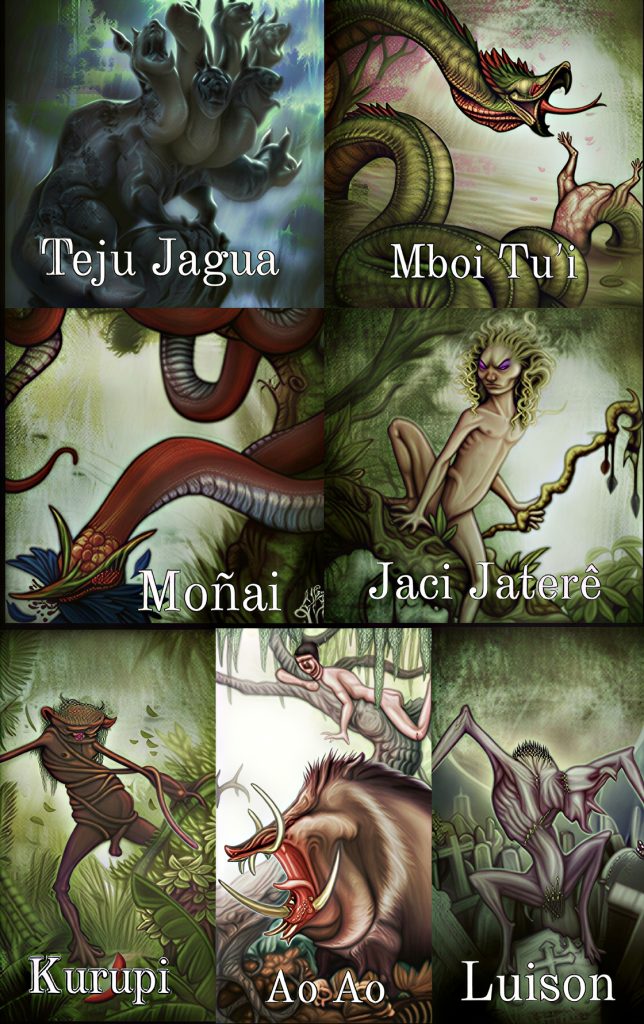
- Teju Jagua: A massive lizard with seven dog heads. Though terrifying, his great weight slowed him, and he protected the fruits of the forest.
- Mbói Tu’ĩ: A giant serpent with a parrot’s head and deadly beak that rules the swamps and wetlands.
- Moñái: A horned snake and lord of the fields, known for his cunning and his habit of hoarding stolen treasures.
- Jasy Jateré: The only brother with a human appearance: a golden-haired child with a magic wand. He lures children away during the siesta.
- Kurupí: The spirit of fertility, a dark-skinned gnome with a massive phallus wrapped around his waist, used to kidnap women.
- Ao Ao: A carnivorous, sheep-like beast with sharp claws that roams the mountains in packs, hunting humans.
- Luisón: The seventh son, the Lord of Death. He roams cemeteries and feasts on the dead, the Guaraní equivalent of the werewolf.
Legacy in the stars
The seven monsters were cast into the heavens. Their spirits became the constellation of the Pleiades (known as Eichu or “The Seven Little Goats”). To this day, the Guaraní look to the night sky and see the Pleiades as a permanent reminder of the seven sins and the seven sorrows: fear, pain, crying, hunger, thirst, sickness, and death, that the children of Tau and Kerana brought to the world.
Yet, this celestial exile was more than a mere sentence; it was a cosmic integration. By pinning these spirits to the firmament, the Guaraní transformed their earthly terrors into an eternal calendar, synchronising the pulse of the forest with the silver arc of the lunar cycle. Each brother, once a predator of the shadows, became a phase of the moon made flesh, a bridge between the stars and the soil.
In this Guaraní cosmos, the myth serves as a profound map where astronomical observation and human frailty converge. These monsters are no longer just creatures of the night; they are the silent guardians of a universal rhythm, ensuring that the lessons of the seven sorrows are never forgotten by those who walk beneath the watchful eye of the heavens.