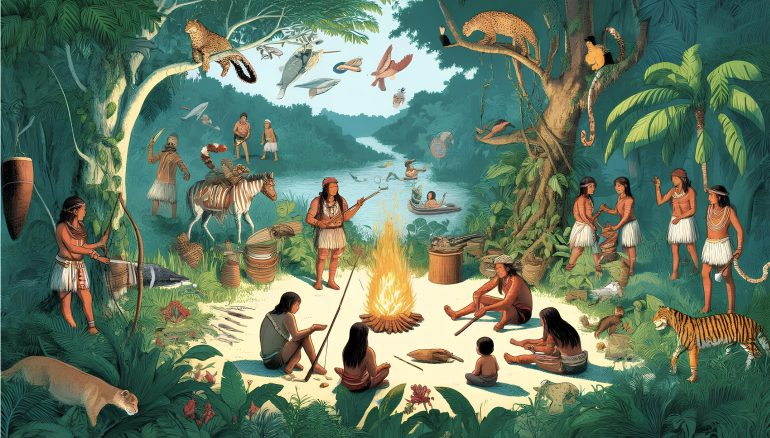

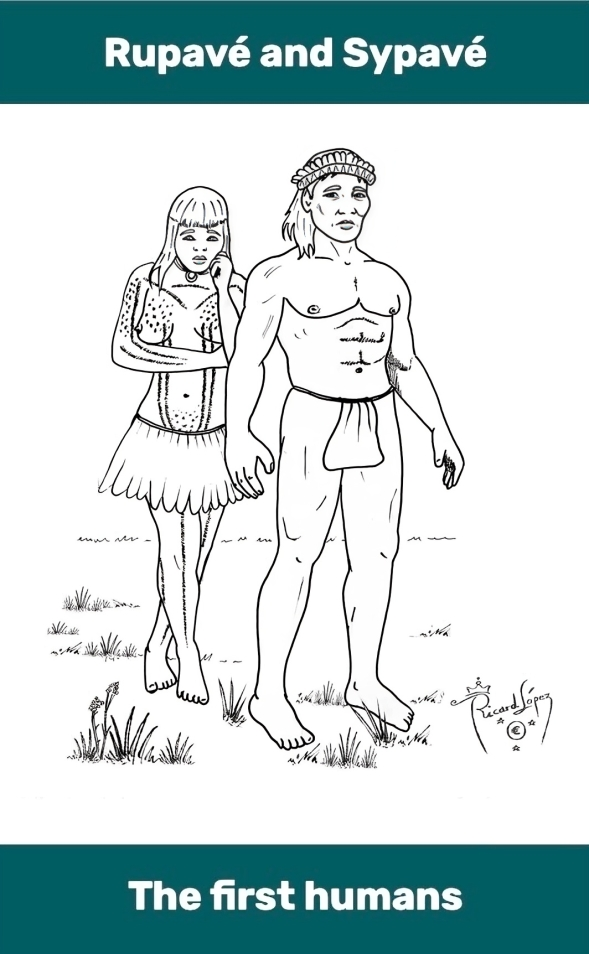
Long before written history, before kingdoms, cities and Paraguay, there was the land of the Guaraní, a vast, untamed world filled with rivers, forests, and mysteries. In this world, the first humans were not born but created by Tupã, the supreme deity of the Guaraní. Rupavẽ and Sypavẽ, “Father” and “Mother of the People,” brought life and shaped the young earth. Much like Adam and Eve in Christian tradition, they became the progenitors of humanity, the source of both virtue and folly.
The sons who shaped the world
They celebrated Tume Arandu, the firstborn, for his wisdom. The Guaraní considered him a great prophet, a guide and teacher whose counsel flowed from the heavens. Wherever he walked, knowledge followed. Tribes looked to him for understanding, and stories of his insight became the foundation of Guaraní moral and spiritual life.
Marangatu, the second son of Rupavẽ and Sypavẽ, embodied generosity and leadership. A benevolent figure, he fathered Keraná, whose unmatched beauty would ultimately lead to one of the most famous sagas of Guaraní mythology: the birth of the seven legendary monsters. Though tragedy followed his lineage, Marangatu’s virtue remained a model of kindness and responsibility.
Then there was Japeusa, the youngest and most infamous of the siblings. Known for deceit and mischief from birth, he embodied cunning and self-interest. His most notorious act was accidentally poisoning his sister Yrasẽma, which led him to drown in despair. Yet death did not end his story; the gods transformed Japeusa into a crab, forcing him to walk backwards for eternity, a living lesson in treachery.
The daughters of strength and sacrifice
Among their daughters, legends speak most vividly of Porãsy, whose beauty and courage was unmatched. She sacrificed her own life to defeat one of the monstrous children of Keraná, saving her people from destruction. Her story is one of bravery and selflessness, echoing through generations as an emblem of virtue.
Tupi Namba was a figure of immense physical prowess who wed Mba’ehory, also known as Amaraso, the brother of Paragua. Communities revere them as the ancestors of the Tupi people. Another daughter is Yrasema, “the murmur of the waters” who possessed a voice of such melodic beauty that it held all who heard it spellbound.
She was a virtuoso of the maraka a sacred gourd filled with pebbles, and reigned as the virgin goddess of music. Her life was tragically cut short when she was poisoned by her own sibling, Japeusa. This marked the first time the tribes witnessed death.
Upon hearing the news of her passing, her betrothed, Jahari, journeyed from Tuvaypy, the “first village,” known today as Tavapy. After singing a haunting lament born of utter despair, he collapsed and died atop his beloved’s grave.
Guarasyáva, famed for her swimming prowess, married Karivé, the “Man of the Sea.” Her tale celebrates harmony with nature, mastery of skill, and a profound connection to the mysteries of the water.
Lastly, the twins, Pytã and Morotĩ, tell a story of conflict and reconciliation. Constantly quarrelling, they drew the attention of Yjára, god of the sun, who punished them in an extraordinary way: forced into an unending embrace, the twins slowly transformed into trees, losing their human forms.
Their legend serves as both a cautionary tale and a meditation on unity, pride, and the consequences of persistent strife.
A family of myths
From crabs walking backwards to daughters who gave their lives for the greater good, the family of Rupavẽ and Sypavẽ embodies the full spectrum of human traits: wisdom, generosity, deceit, courage, and stubbornness. Through their stories, the Guaraní teach morals, explain nature, and preserve identity.
These first humans, though created by a deity and living in a world of myth, remain timeless symbols. Their lives and those of their children continue to inspire, caution, and enchant, proving that even in legend, humanity’s virtues and vices are universal.