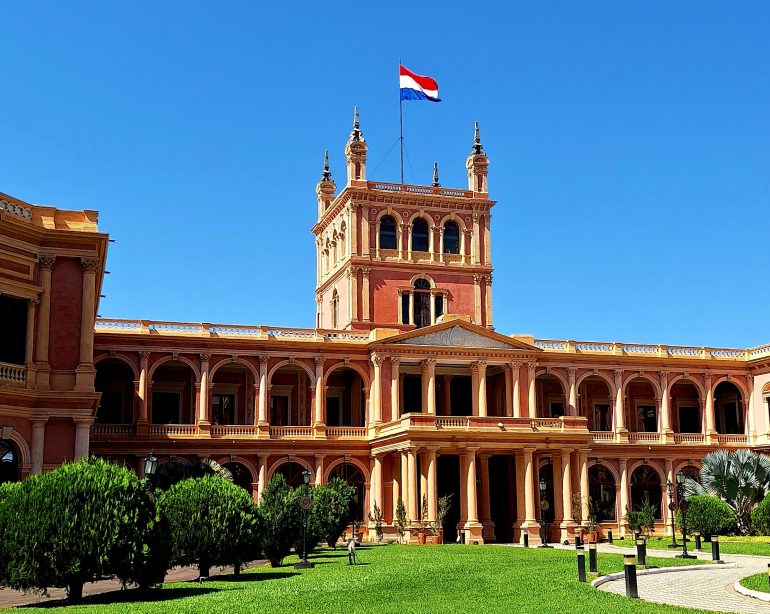

Paraguay’s Presidential Palace, built in 1857, has long kept its secrets – until now. A new glimpse inside reveals the official resolution to the age-old debate over its true front façade, marble columns painted with bovine blood, repatriated 19th-century mirrors and paintings, and much more. The Asunción Times went inside the Presidential Palace Of Asunción, with Paraguay’s National Secretariat of Tourism (Senatur).
Senatur has introduced a unique experience titled “Secrets of the Palace”, a guided tour through the palace. The tour leads visitors through symbolic corners, hidden stories, and architectural details of Paraguay’s most iconic building.
The eternal question: which side is the front?
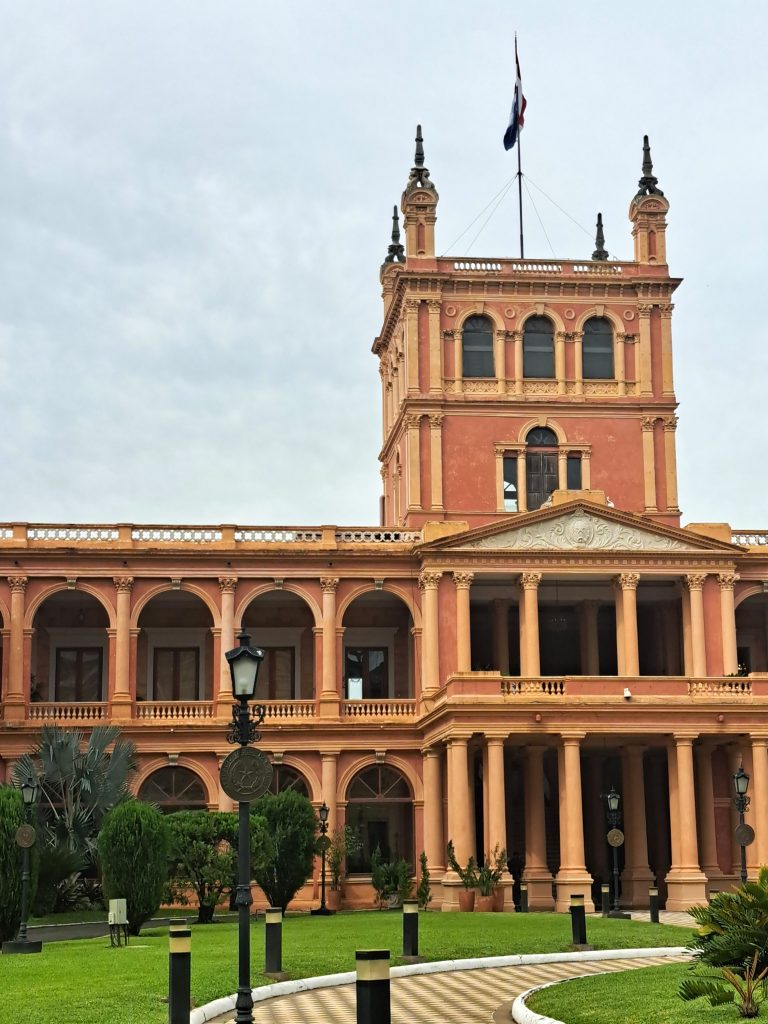
Institutions have finally answered the long-standing question regarding the true front of the López Palace: to avoid controversy, they now officially recognise two façades. The architectural front, marked by the Paraguayan white coat of arms and the Italian stairway, serves as the main entrance.
The historical front faces the Paraguay River and reflects the era when affluent families oriented their summer residences towards the palace. Entering through this side, however, leads directly to the basement stairs, an unsuitable access for welcoming official guests.
The Hall of the Marshals in the Presidential Palace of Asunción
The first room on the tour is the Hall of the Marshals, painted in English green and mint, evoking serenity. Two essential figures in Paraguayan history are displayed here:
- On the left, hangs the portrait of Marshal José Félix Estigarribia, Commander-in-Chief during the Chaco War, exiled in Uruguay for six months due to political issues, and President of the Republic until his death in 1940. Painted in that same year by the Polish artist Wolf Bandurek, the piece is titled “The Marshal’s Last Glance.”
- On the right, stands an imposing portrait of Marshal Francisco Solano López by Guillermo Da Re, created around 1900, depicting him on a white horse. In pictorial language, a mounted rider symbolises combat; one raised hoof indicates injury, while two raised hooves, as in López’s case, symbolise death in battle.
The furniture in this and other rooms dates from the 1920s, featuring a neoclassical style with gold-laminated wood. For years, they used this space as an office divided into eight cubicles, and they inaugurated it as a hall only in 2013.
The Ministers’ Hall and the vestiges of war
Behind the Hall of the Marshals lies the Ministers’ Hall, where most meetings known to the public and the press take place. It features large windows, 32 armchairs, and a long wooden table.
Leaving this room leads to a corridor redesigned in 2021 to mirror the aesthetic of the second floor. Here, they display remnants from the Triple Alliance War: construction fragments, cannons, and wooden pieces made from urunde’ymi, a material capable of resisting more than two hundred years underwater. Workers discovered these remains in 2020 during reconstruction works.
The tour continues to the staircase, the only original structure that survived the Brazilian looting. The Italian Andrés Antonini designed the staircase, which leads to a pastel ceiling resembling Asunción’s sky, painted by Félix Toranzos.
Non-marble columns and the Liberty Hall
On the second floor, the pink columns appear to be marble but were painted by Paraguayan artists. Marshal López’s original plan intended for imported European marble, but transport would have taken years. Local artists instead simulated the material using techniques involving plant pigments and bovine blood.
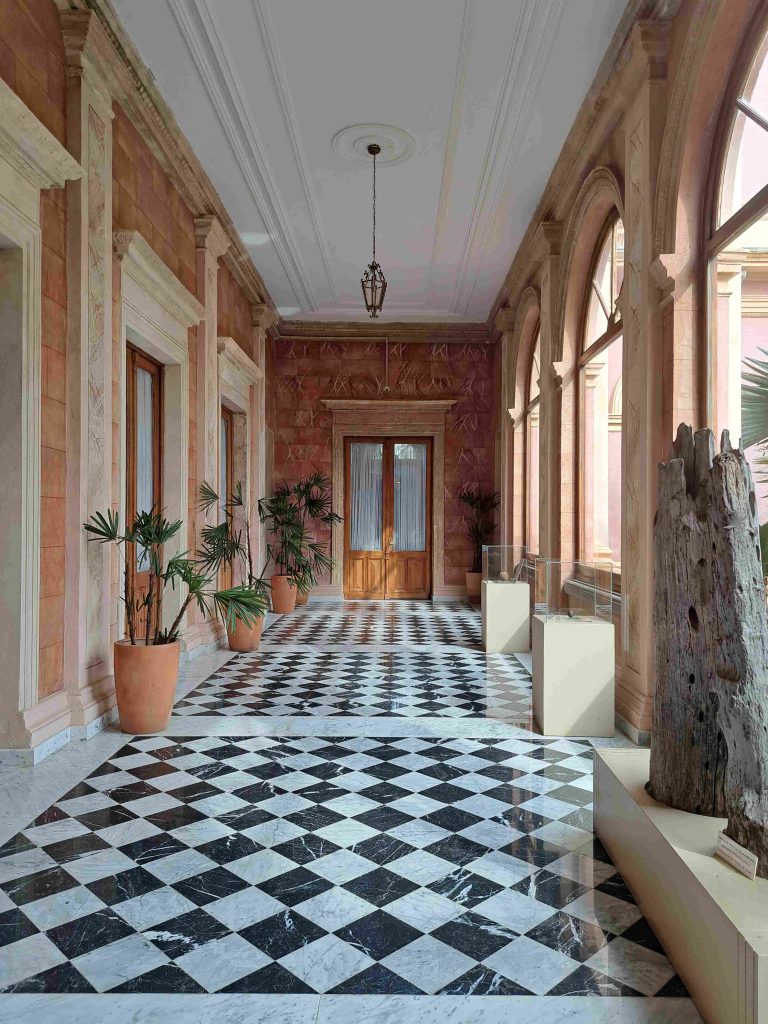
Its colour resembles that of the Argentine Casa Rosada and provincial buildings of the neighbouring country. To the right lies Liberty Hall, dominated by yellow tones. Its reconstruction, authorised by former President Mario Abdo Benítez, involved a team of 25 people.
The hall stands out for its gold-laminated furniture, pale pink upholstery, and a majestic 19th century mirror found in Piribebuy, owned by an elderly couple. Experts believe that a piece of such luxury must have belonged to someone of Madame Alicia Lynch’s economic standing.
During the presidency of General Andrés Rodríguez (1989–1993), the original tiled floor was replaced with parquet, which remains to this day. The hall connects to two family-style rooms, likely intended for Lynch and Marshal López. A service corridor surrounds both. Although they had seven children, the couple never lived in the Presidential Palace of Asunción because the war began before its inauguration.
Brazilian and Argentine forces seized the palace, and authorities inaugurated it as the presidential residence in 1894 after abandoning educational plans.
Several halls contain French-style mirrors laminated in gold and decorated with early 20th century paintings. These artworks do not depict national or historical scenes and are unsigned, suggesting they were painted by students or Paraguayan artists.
The Hall of Mirrors
On the left wing is the Hall of Mirrors, which, in addition to its French mirrors, houses large pieces and painting of Marshal López found in Cuba. Once authenticated, they were sent as gift to Paraguay. A portrait of Chancellor José Berges is also displayed. These works lead to the former presidential office, used by Juan Egusquiza from 1938.
Officials moved the office downstairs in 1949; the President still uses it today, while visitors can only view the old office through a window.
A symbolic closing
The tour concludes in an extension of the Hall of Mirrors, decorated in mint green and gold ornaments. Here hangs one of Paraguay’s most recognisable artworks: the scene depicted on the back of the 10,000-guaraní banknote, featuring Dr José Rodríguez de Francia at front.
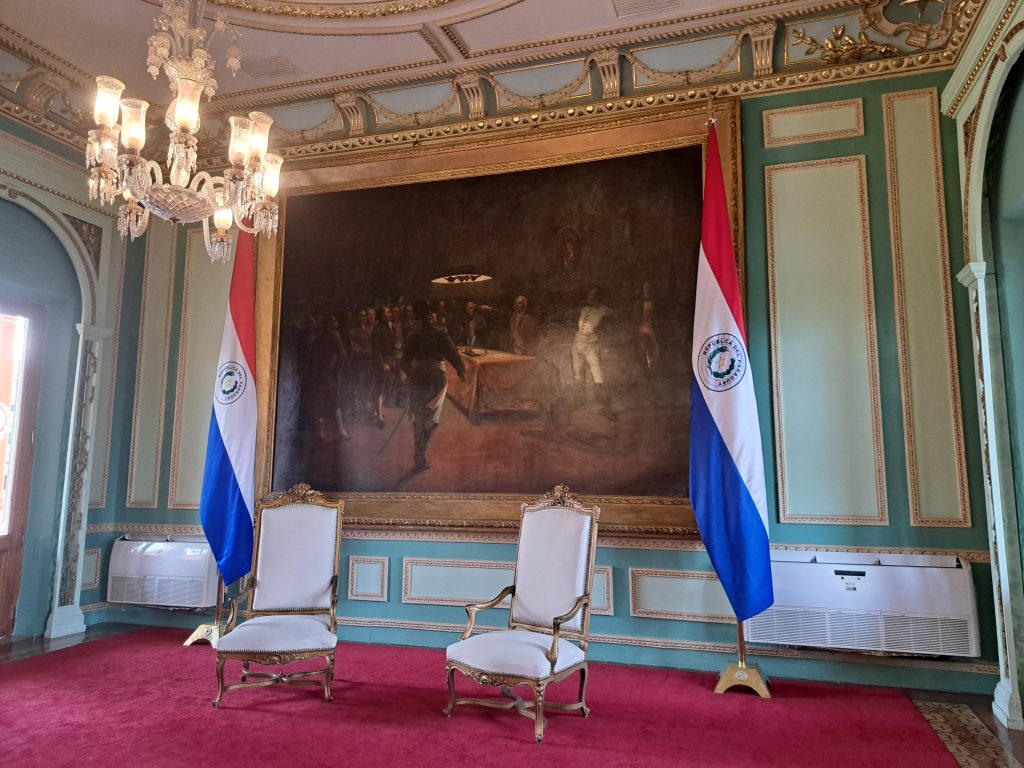
Painted in 1907, signed by Guillermo Da Re, and titled “14th of May, Intimation to Velasco,” it represents a fictional scene from Paraguayan independence. The accusatory pose symbolises Paraguay condemning repression. A notable detail is the small portrait in the background, something Rodríguez de Francia considered a bad omen.
The palace’s pinnacles face the four winds, and repeated motifs of thirteen and five reflect López’s symbols of change and perfection.
Schedules and reservations
This experience forms part of a tourism initiative in which military officers guide the tour every Friday at 10:00 and every Saturday at 18:00. Admission is free, but prior reservation is required due to limited capacity. For bookings and further information, visitors may contact +595 983 981 212, or follow the official SENATUR social media.
There is no better way to understand Paraguayan history than by walking through the corridors of its governmental palace, a witness to luxury and misery, war and rebirth: a living mirror of the nation’s identity.
To discover more about what Paraguay’s capital has to offer beyond the Presidential Palace of Asunción, see our 12 Amazing Things to Do in Asunción.