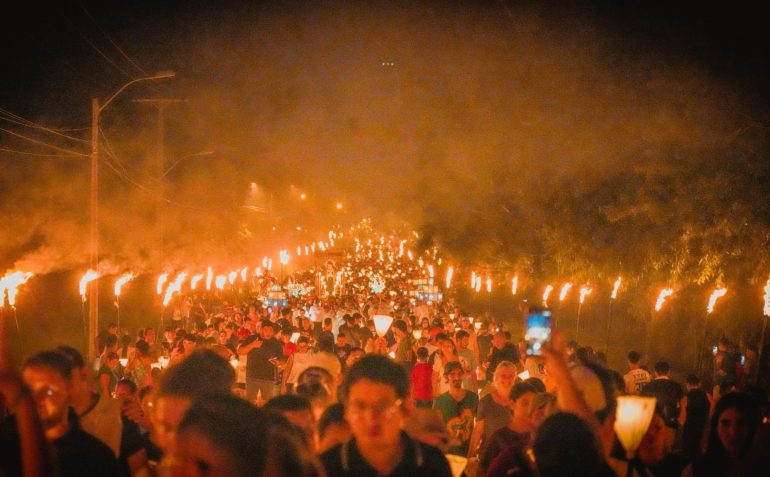

The annual Tañarandy festival once again illuminated the Paraguayan town of San Ignacio, drawing thousands of visitors for one of Paraguay’s most profound cultural and spiritual events. On Good Friday, the community honoured the legacy of artist Koki Ruiz, the festival’s creator, under the radiant glow of 20,000 handmade candles. The Holy Week 2026 celebration held particular significance, being the first since Ruiz passed away in December 2024.
Thousands of people, including both Paraguayan residents and international tourists, travelled to San Ignacio to participate in the cherished Holy Week tradition. The event, first established by Ruiz in 1992, has since grown into a major national spectacle. The experience is designed to connect attendees with the deepest essence of Paraguayan culture, blending religious solemnity with powerful artistic expression.
A tradition of art and faith
At the heart of the festival is the lighting of candles made from apepú, the bitter orange. These 20,000 lights line the procession route, creating a mesmerising and contemplative atmosphere that captivates all who attend. The soft, flickering light transforms the streets into a sacred space, guiding participants on a journey of reflection. Furthermore, the event serves as a living tribute to its visionary founder, Koki Ruiz, whose artistic spirit continues to define the celebration.
This year, the centrepiece was a magnificent Gothic-style altarpiece, which stood an impressive nine metres high and measured sixteen metres wide. This structure provided a dramatic backdrop for the evening’s proceedings and showcased the high level of artistry involved in the production.
The procession of Our Lady of Sorrows
A key moment of the evening was the solemn procession of the Virgen Dolorosa, or Our Lady of Sorrows. The procession moved slowly along the Yvaga Rapé, a term which translates to the “Path to Heaven.” This candlelit walk is a deeply symbolic part of the Tañarandy experience, allowing for quiet contemplation and shared reverence among the enormous crowds. The procession began at the Basilica Sanctuary, a significant landmark in the region.
From there, the procession wound its way through the main avenues of San Ignacio, a city known as the “capital of faith,” which recently celebrated its 256th anniversary.
Dramatic reenactments captivate crowds
The theatrical element of the Holy Week 2026 festival was brought to life by the Pasión de Cristo ensemble from Zanja Hû. Their powerful performance of the Passion of Christ unfolded throughout the evening, engaging the audience in the biblical narrative.
The culmination of the performance took place at Parque Lagorã, which became the setting for the most poignant scenes of the crucifixion. This segment of the event enveloped the audience in a profound spiritual message, creating a deeply moving and memorable experience. The quality of the reenactment helps to maintain the tradition’s vitality and ensures its powerful message resonates with new generations.
Tourism Minister Angie Duarte highlighted that the city of Encarnación experienced 100% occupancy in hotels and inns authorised and registered by the National Tourism Secretariat (Senatur) through Easter Sunday.
“The full occupancy rate in Encarnación reflects the confidence of visitors and the appeal that our country offers at this time of year,” the minister stated.
Holy Week 2026 celebrations across Paraguay
While Tañarandy is a major highlight, it was just one of several emotive events that take place across Paraguay during Holy Week. In Valenzuela, for example, crowds gathered for the Ta’anga Oikovéva, or “Living Pictures,” where biblical scenes were recreated in elaborate tableaus. Similarly, another significant event was the Via Crucis, or Way of the Cross, held at the Jesuit Mission of Jesús de Tavarangue.
The Yacyretá Binational Entity received hundreds of visitors during Holy Week, who came to see this emblematic engineering work and enjoy its natural surroundings. In this edition, the tourist proposal was enriched with a craft fair, in addition to traditional activities such as the making of chipa in the square, which allowed visitors to experience Paraguayan customs up close.
During the morning session, approximately 1,000 freshly baked chipas were distributed free of charge, accompanied by cocido, a type of stew.