

Arturo Fleitas, who appears in the recent Paraguayan film Narciso, has come a long way. The actor and director was exiled from Paraguay in the 1950s and developed a successful career in theatre in Uruguay and Mexico. And now appears in Narciso, a movie that happens in the dictatorship he lived and suffered.
He has retired from theatre direction and plays. Despite his advanced age, his role in Narciso not only pays homage to his career, but also makes him want more in the film industry. The Asunción Times speaks with the legendary artist, in a talk filled with passion for cinema, praise for the cast and director, and more.
What does Narciso means for Arturo Fleitas?
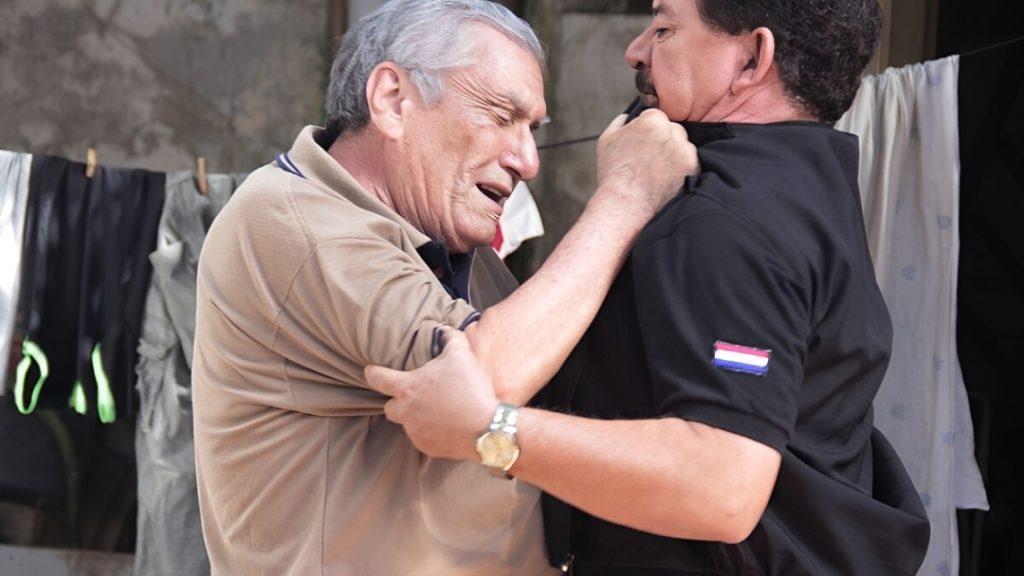
Arturo Fleitas has spent 55 years in theatre plays. He is a legend of Paraguayan, Uruguayan and Mexican theatre. He jokingly says that he has “the privilege of being exiled 4 times”. Narciso means two fundamental things for him.
“First, Narciso means to recover a terrible, important and criminal part of history that should not be forgotten. In second place, it means an extraordinary artistic experience. Marcelo Martinessi´s production and his team is a first-world class production. His aesthetic is so advanced that the public needs to be attentive to see all the signs in the film”, Arturo Fleitas begins.
Acting for Marcelo Martinessi
“Marcelo does not have a direction that tells you to things. Instead, he talks, listens and watches you and with these, you construct the character. It is a collective construction. One does never act alone”, Fleitas explains.
“The film has already won a prize. Marcelo is a master in cinema and works with the actor face to face. Luis Arteaga, his photograph director, works the same way. So you are between friendly faces that are watching and conducting you permanently. I am an actor that gives himself to the direction. And that is what happens in this case. I absolutely trust Marcelo and Luis Arteaga”.

Narciso´s reception
“I think the public will receive the movie in a good way. For those who lived those times, it will bring back the memories of that terrible and dark times that they lived. I had the sad privilege of living it too. For those who did not live in that era, Narciso it is going to recover a story that they did not know about”, says Fleitas.
“This real thing that happened, the murder of the broadcaster was forgotten. Guido Rodríguez Alcalá recovered it for his novel and Marcelo did another thing with him. So, the history of Paraguay is brought forward. The public, I think will take it like that. People that want a Paraguay that moves forward in liberties and democracy, is going to like the movie”.
Arturo Fleitas´s thoughts
“Narciso reflects the dictatorship, but just for a minority. But you can transport this oppression that this little group lived to the oppression that all of the country suffered. But not just in the characters, it is also in the scenography. Because it is a dark Asunción, and there is a great lightwork and art work. Marcelo wanted to transmit that darkness that we lived in”.
“It was not easy for me doing this work. I was very happy doing it, but I suffered a lot. For mental and physical reasons. I lived that. There is this thing that happens to us that we lived in that era: When we talk about those pains, we suffer them again. For example, the fear. It is awful to live in fear,” Arturo Fleitas recalls.
Narciso´s legacy
“Its legacy is very big. All of Marcelo Martinessi´s work is like that. He is a big beam of light that illuminates Paraguayan cinema. And the culture. Not just in film, but it is a way to confront reality. Marcelo responded in Berlin to that.”
“The film pays very good homage to Bernardo Aranda, the broadcaster. That boy was very joyful. He is a symbol of the victims of the repression. And in that time, being a promoter of rock and roll was an attack of the way of life. Or at least those were the dictatorship’s thoughts.”
Arturo Fleitas role

“I think my character is the most theatrical one. Because cinema needs authenticity, but my character needs artifice. In that artifice, the Dracula scenes are a metaphor of what is happening in the country. So, artifice and authenticity need to join and it was really hard to do that, but I think it worked. For that, Marcelo found a synthesis that his artificial character at the end takes off his makeup and appears this very dramatical, real, poor and helpless character,” he explains.
“I loved doing radio theatre. Because I did it, it was like you see in the movie. With all of those rudimentary special effects. There is a lot of truth in the film, but in the radio theatre scenes comes again the artifice. It sets a different tone in the film.”
“When the soldiers came in the film, it was very hard for me. For example, the smell of young soldiers in green uniforms made me felt the same way of the soldiers of that time. Or the same smell and feeling when I did the military service. But cinema is made with truth or is not made.”
What lies in the future for Arturo Fleitas
“Narciso is at the same level of 7 Boxes or The Heiresses. I suspect that the film could become a landmark of Paraguayan cinema. And for me, despite being retired from theatre, I want to do more films. I do not know if Narciso ends on a high note my career, but I would not be mad if that is the case.”
Finally, Arturo Fleitas invites everybody to see the movie. “I do not like to give or receive advice. But everybody needs to see Narciso and feel great afterwards.”