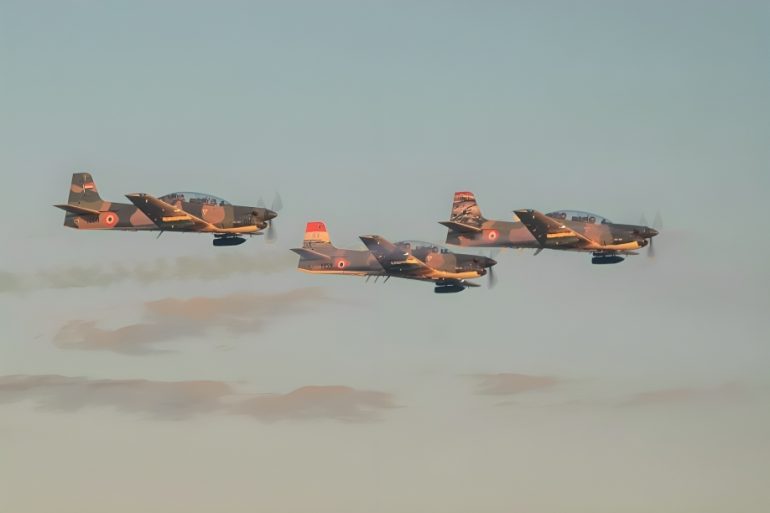

Paraguayan authorities have detailed a successful operation that resulted in the seizure of a significant drug shipment. The mission involved the country’s newly acquired Super Tucano aircraft intercepting a plane carrying 450 kilograms of cocaine base paste. This event showcases a major success for the nation’s enhanced aerial defence and anti-trafficking strategy, demonstrating the immediate impact of recent investments in military technology.
Government officials held a press conference to discuss the operation. Key figures, including Paraguay’s Minister of National Defence, the Commander of the Air Force, and the head of the National Anti-Drug Secretariat, underscored the effectiveness of the new equipment, and the high level of inter-agency coordination.
A timely radar detection
The operation began when the Paraguay’s recently upgraded radar network identified an unauthorised flight. Julio Fullaondo, the Commander of the Paraguayan Air Force, explained the initial detection. He stated that at approximately 13:45 on 31 January, 2026, the system flagged an irregular flight which had failed to file the mandatory flight plan. This immediate alert was the crucial first step in the chain of events that led to the interception.
Fullaondo provided a direct account of the rapid response. He explained that a Super Tucano aircraft, already conducting patrols in the northern region of Concepción, was immediately dispatched to intercept the suspicious plane. The swift deployment of the Super Tucano, a light attack aircraft well-suited for such missions, highlights the air force’s improved reaction capabilities in a region known to be a corridor for illicit activities.
Cross-border pursuit and international coordination
The Commander continued by describing the pursuit that followed the initial interception. According to Fullaondo, the chase continued for several minutes, during which the irregular aircraft eventually crossed the border into Brazilian airspace. This transnational element made cooperation with neighbouring authorities essential for a successful outcome. He noted that active and efficient coordination with security forces in Brazil proved vital.
Paraguayan officials were quickly informed that the fugitive aircraft had been forced to make an emergency landing. The landing occurred on Brazilian territory, reportedly because the plane had run out of fuel during the extended pursuit. Consequently, the cargo was impounded by the Brazilian Military Police before being transferred to the Federal Police in the border city of Ponta Porã.
A victory for national anti-drug efforts
The head of the National Anti-Drug Secretariat, Jalil Rachid, confirmed the contents of the seized cargo and praised the operation’s execution.
“It was 450 kilos of base paste, cocaine hydrochloride, that was seized thanks to the deployment of our Super Tucanos in the air, and the inter-institutional work that was carried out among all the institutions that intervened,” Rachid said.
“A clear signal against organised crime”
The Minister of National Defence, Oscar González, placed the operation within the government’s broader security policy. He noted that the acquisition of the Super Tucano planes and the repair of two mobile Israeli radar systems are central to a strategy of asserting control over national territory, and combating drug trafficking. These assets are now being deployed for continuous surveillance across the country.
“The decision of the Government of Paraguay to combat organised crime in any of its facets is being demonstrated conclusively with this operation and with others that we are permanently carrying out throughout the territory of Paraguay,” González said.
This successful operation, González concluded, serves as a powerful demonstration of Paraguay’s renewed capacity and political will to secure its airspace, and collaborate with its neighbours to disrupt transnational organised crime.