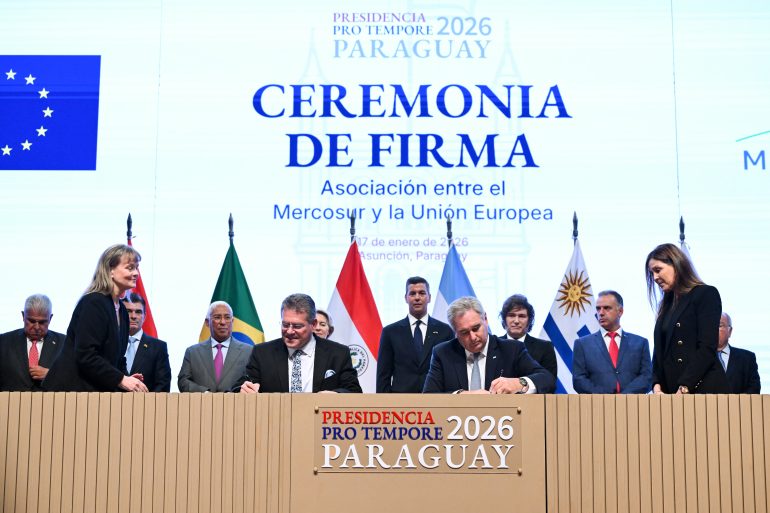

The historic signing of the EU-Mercosur association agreement in Asunción marks a turning point for South American trade. With preferential tariffs and a focus on Paraguayan exports, the deal is set to transform the nation’s economy. The recent signing of the EU-Mercosur agreement in Asunción has positioned Paraguay as a central player in international diplomacy. Beyond the regional impact, the pact includes specific preferential benefits for Paraguay, acknowledging its unique status as a landlocked economy.
Paraguay competitiveness in the EU-Mercosur agreement
According to government officials, this “special and differential treatment” ensures that Paraguay can compete effectively within the European market while protecting its domestic industries. The Foreign Minister emphasised above all the significance of free access to over 800 million people and the connection with one of the world’s most demanding markets, the 27-member European Union. “It represents the challenge of generating the levels of competitiveness we need,” he says.
“Furthermore, the EU-Mercosur agreement represents a spectacular investment opportunity for our country, considering the benefits, which will be phased in gradually. We are talking about a 93% tariff reduction over 15 years, more than US$65 billion in benefits for the countries involved, and clear rules governing this trade relationship,” he adds.
For the European Union, the agreement primarily represents an opportunity to increase exports to Mercosur. This would be benefiting above all some 30,000 small and medium enterprises (SMEs) that already export to the region.
US$65 Billion in tariff preferences
The scale of the deal is unprecedented. The European Union has granted tariff preferences to Mercosur valued at over US$65.7 billion. Key highlights of the fiscal benefits include:
- 92% Duty-Free Exports: The EU will eliminate tariffs on the vast majority of Mercosur goods. The percentage represents approximately US$61 million. Additionally, preferential access for 7.5% of exported products, representing US$4.7 billion.
- Paraguayan Export Quotas: Specific allocations for 1,500 tonnes of pork, 50,000 tonnes of organic sugar, and 50,000 tonnes of biofuels.
- Automotive Growth: Significant tariff reductions for the auto-part industry, a burgeoning sector in the Paraguayan economy.
Minister Angie Duarte on tourism and investment
The decision to host the EU-Mercosur agreement signing ceremony in the capital was a strategic win. Tourism Minister Angie Duarte highlighted that the Asunción signing serves as a global “shop window” for the country. “Paraguay is projecting itself to the world as a reliable and stable partner,” Duarte notes.
The government expects the agreement to trigger a surge in receptive tourism and foreign direct investment (FDI). The European businesses will look to tap into the country’s competitive tax regime and renewable energy surplus.
Strengthening institutions and OECD aspirations
The EU-Mercosur agreement is build on three pillars: trade, political dialogue, and cooperation. For Paraguay, the political pillar is a vital stepping stone toward joining the OECD.
Through the EU’s Global Gateway Initiative, Paraguay will receive support to modernise its legal frameworks and improve transparency. Foreign Minister Rubén Ramírez confirmed that while the deal facilitates trade, it also respects national sovereignty regarding environmental and social regulations.
Ratification and implementation of the EU-Mercosur agreement
President Santiago Peña’s administration is moving swiftly to ratify the pact. The document will be presented to Congress this week, followed by a series of consultations with industrial guilds. With a 15-year transition period for certain tariff reductions, Paraguayan businesses will have ample time to adapt to the standards of the European single market.
Picture from The European Union – Frederic Sierakowski