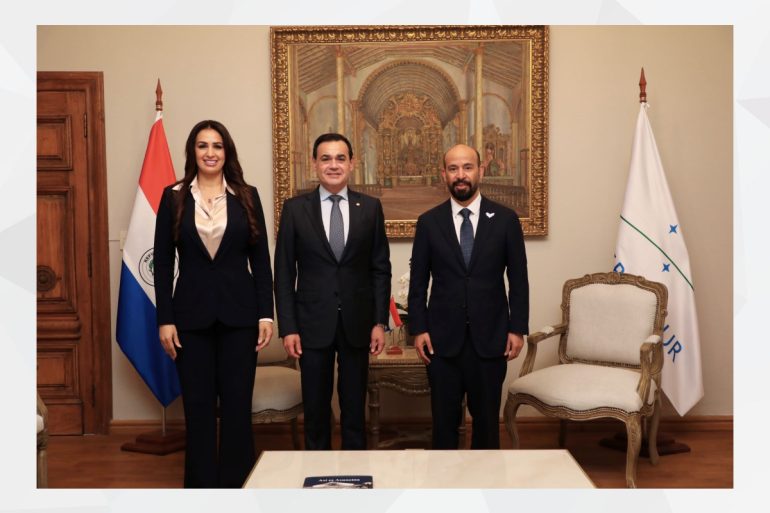

As we enter 2026, the economic distance between the heart of South America and the Arabian Peninsula has never felt shorter. Driven by a mutual need for food security in the East and infrastructure capital in the West, Paraguay has forged a sophisticated network of trade and investment with the Gulf Cooperation Council (GCC) nations. The United Arab Emirates, Saudi Arabia, Qatar, and Kuwait became over time strategic partners of Paraguay. Thus, opening an economic stream for La Tierra Guaraní in the Arabian Peninsula and the Middle East. The Asunción Times was already mentioning the growth of partnership between Paraguay and the Middle East in early 2025.
Early 2026, the Minister of Foreign Affairs of Paraguay Rubén Ramírez Lezcano said that the relationship with the Arabian Peninsula has transitioned from occasional trade to a deep-seated structural partnership. He also added that Paraguay is no longer just a farm but rather a strategic logistics node.
The United Arab Emirates: The strategic gateway
The United Arab Emirates has emerged as Paraguay’s Arabian Peninsula’s most significant partner. Acting not only as a buyer but as a vital investment hub. In 2024, trade between the two surpassed US$350 million, with a notable 23.5% annualised growth in Paraguayan exports over the preceding five years.
Primary Exports: Paraguay’s primary exports to the UAE include gold (valued at approximately US$ 107 million annually), soybean meal, and maize.
Energy and Technology: Following high-level summits in mid-2025, Emirati investment has pivoted toward Paraguay’s clean energy sector. Joint ventures are currently exploring the use of Paraguay’s 100% renewable electricity grid to power green hydrogen production and large-scale data centres.
The MERCOSUR-UAE CEPA: As of January 2026, negotiations for a Comprehensive Economic Partnership Agreement (CEPA) have entered their final stages. The deal is promising to eliminate tariffs on over 90% of bilateral trade.
Saudi Arabia: The food security anchor
Saudi Arabia has focused its relationship with Paraguay on securing long-term agricultural supply chains to support its Vision 2030 goals.
The Beef Boom: Since the 2024 opening of the Saudi market to Paraguayan bovine meat, exports have surged. While traditional destinations like Chile remain dominant, Saudi Arabia has become a key premium buyer.
Agro-Industrial Flows: Data from the UN COMTRADE database indicates that in 2024, Paraguay exported roughly US$16.9 million in soybean oil-cake and animal fodder to Saudi Arabia. This is vital for the Saudi livestock industry.
Energy Imports: In return, Saudi Arabia remains a primary source of refined petroleum for Paraguay, with annual imports exceeding US$70 million.
Qatar and Kuwait: social and structural support
While smaller in trade volume than the UAE or Saudi Arabia, Qatar and Kuwait play specialised roles in the Paraguayan economy.
Qatar: Focuses heavily on Social Development and Family MoUs (signed late 2025). This is alongside strategic consultations for the OIC Strategic Plan for Food Security 2026-2035. In this plan, Paraguay is viewed as a “model partner” for external agricultural sourcing.
Kuwait: Historically, the Kuwait Fund for Arab Economic Development has provided concessional loans to developing nations. In Paraguay, these discussions have recently focused on irrigation infrastructure and water management. The aim is to bolster crop yields during South American drought cycles.
The Bioceanic Corridor: A game changer
Central to this alliance is the Bioceanic Corridor. This road network links the Atlantic port of Santos (Brazil) to Pacific ports in Chile, passing directly through the Paraguayan Chaco. For the Arabian Peninsula, this route is revolutionary. This corridor allows Paraguayan goods to reach the Pacific. This is cutting shipping times to Asia and the Middle East by up to two weeks. Gulf sovereign wealth funds have recently shown increasing interest in the logistics hubs sprouting along this corridor.