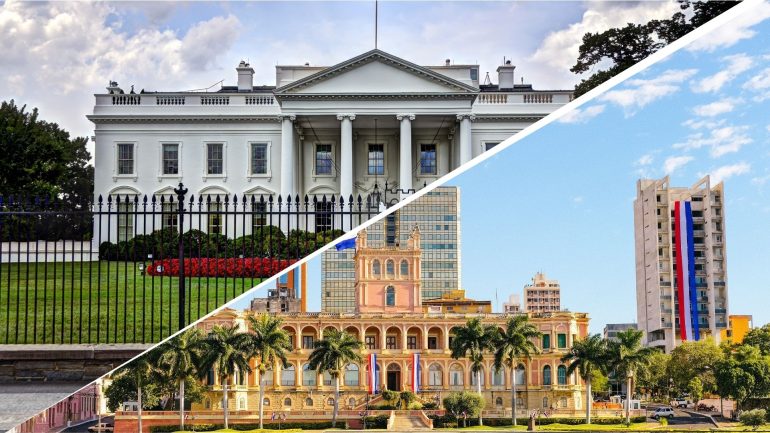

The Municipality of Asunción is the capital and biggest city of Paraguay. The metropolis is part of no Department, but rather part of its own Capital District, like Washington, Mexico City, and Brasilia. How did the city become independent from the rest of the departments? This is the story behind Paraguay’s independent capital.
A country composed of Departments
Asunción did not have a clear status until 1973. That year, Law No. 426 divided the country into 19 Departments. At this time, the city was often listed alongside them without an official designation. Asunción still functioned as the central administrative hub of the country.
In 1992, with the Article 1 of the Constitution of Paraguay, it is declared that the country is composed of Departments, Municipalities, and a Capital District. That same year, with Law No. 71, it officially gave the status of an autonomous municipality to Asunción, thus becoming more formally the Capital District of Asunción. With this governing structure, how does Asunción stand out compared to cities such as Washington, D.C.?
Comparison capitals and governing bodies
The designation of an independent, federally administered area for a nation’s capital is a common political architecture, designed to prevent the central government from being unduly influenced by a single state or department. Both Asunción, Paraguay, and Washington, D.C. in the United States, embody this structure, yet a comparative analysis of their political and financial frameworks reveals a profound disparity in local sovereignty.
In essence, while Paraguay’s independent capital’s municipal leadership enjoys a high degree of autonomy enshrined in its constitution, D.C.’s local government remains fundamentally a subordinate creation of the U.S. Congress.
Constitutional bedrock: Independence vs. subordination
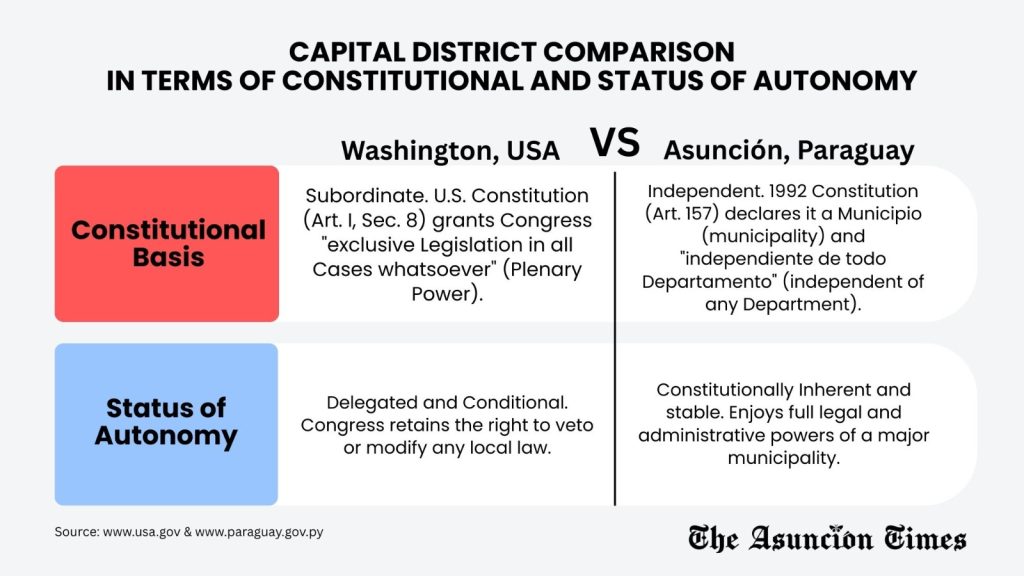
The difference in legal power stems from the national foundational documents that created these districts. Article I, Section 8 of the United States Constitution grants Congress exclusive legislation over the city. This article gives the government power to change or adapt plan of the city.
As for Asunción, apart from Article 1 of the 1992 Constitution, Article 157 is also in play. This one states clearly that the city is independent from all the existing Departments of Paraguay. While territory cannot be subtracted, as it would remove parts of the city, territories can be added. For example, a place such as Nueva Asunción could be annexed in the future and be part of the Capital District.
The executive divide: mayoralty and local control
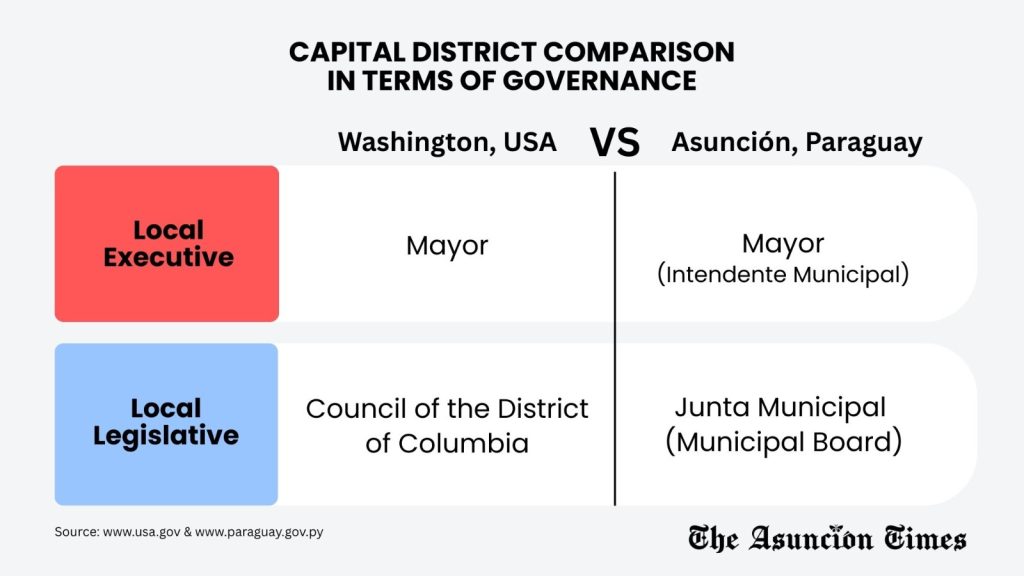
Both capitals are governed by a directly elected Mayor and a local legislative council, but the reach of their respective executive powers differs significantly. The Mayor of Asunción works with a Municipal Board and the Mayor of Washington works with a Council.
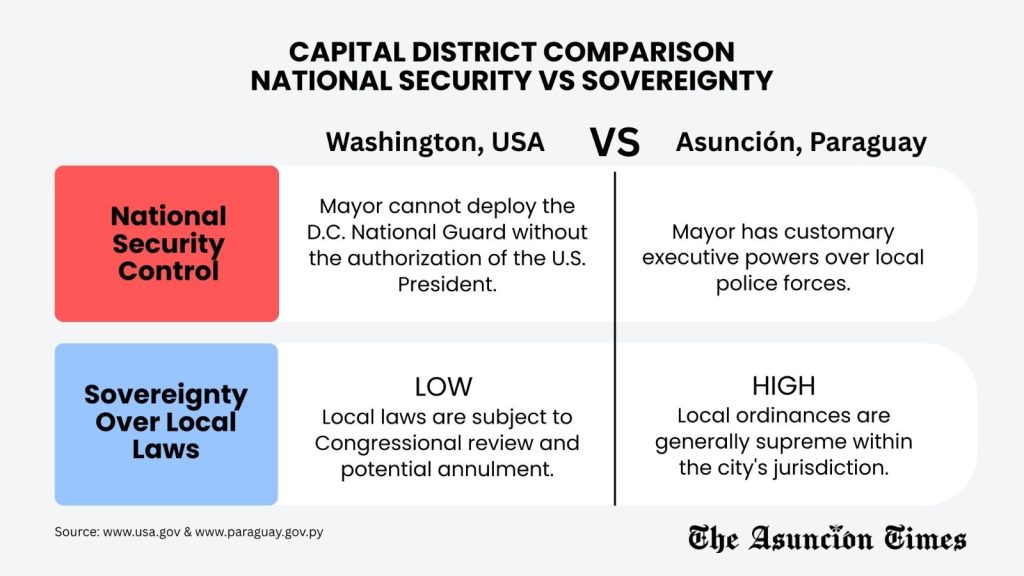
Autonomy differs, especially over laws, regulations, and authorisations. The Mayor of Washington cannot deploy the National Guard with the President’s consent. In Paraguay, the Mayor of Asunción can deploy police forces and more if needed. The Intendent and the President work hand-in-hand rather than one for the other. The city of Washington cannot pass laws by themselves, contrary to Asunción.
The budgetary divide: size and financial oversight
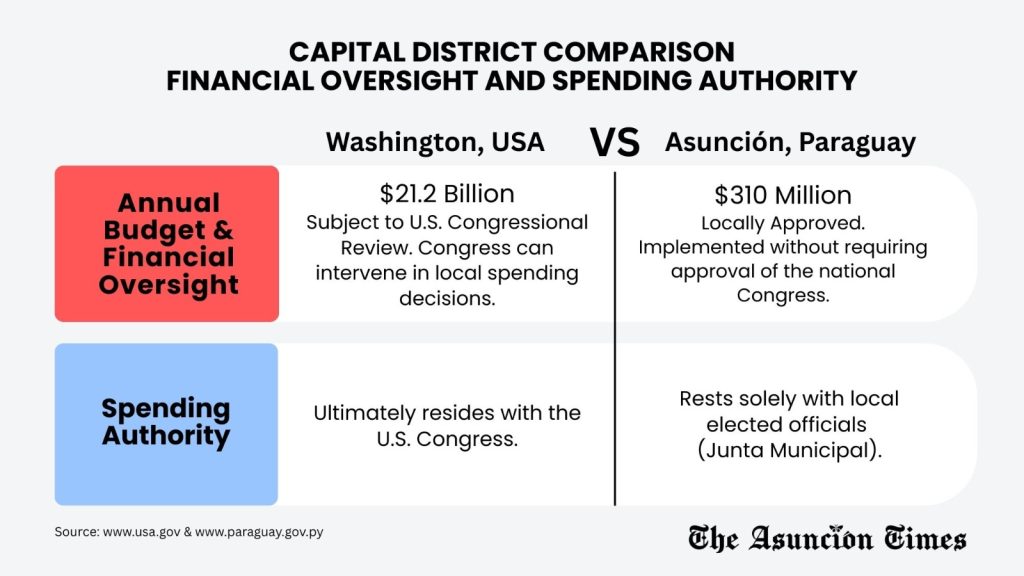
The comparison of budgets not only highlights the economic gap between Paraguay and the U.S. but also underscores the crucial distinction in financial oversight. In American Dollars (USD).
Washington, D.C., generates massive tax revenues, but even the local portion of its $21.2 billion budget is submitted to Congress for a “passive” review. Crucially, the final authority to determine how D.C. spends its own money ultimately resides with the U.S. Congress, a body in which D.C. residents have no voting representation. In contrast, Paraguay’s capital financial structure is heavily reliant on its own resources. Local property and business taxes often account for over 85% of municipal revenue. This high degree of local funding contributes directly to its administrative independence.
Sovereignty is king
The structural comparison clearly demonstrates that while both Asunción and Washington, D.C., serve a common governmental purpose, they possess vastly different degrees of Capital City Autonomy.
The Mayor of Washington, D.C., despite overseeing a budget over 50 times larger, ultimately serves at the discretion of a distant national legislature. The Mayor of Asunción wields the authority of an executive governing an independent entity, with budget and legislative decisions resting solely with local elected officials. In the case of case of Washington, D.C., political oversight remains the enduring constraint on local rule. For Paraguay’s independent capital, constitutional protection grants genuine sovereignty.
Made in collaboration with Villya Christin Purba.
Read more: Safety In Asunción: A Data-Driven Look At Security In Paraguay’s Capital.