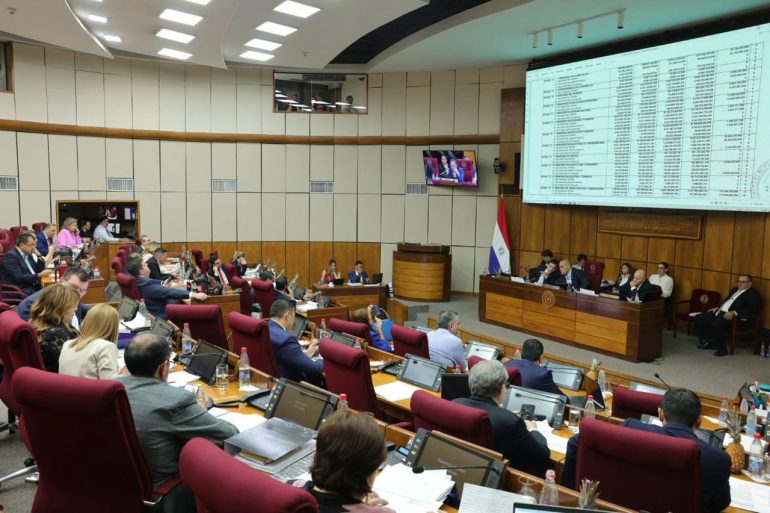

In an extended extraordinary session lasting more than twelve hours, Paraguay’s Senate approved the 2026 General Budget of the Nation (PGN) with several modifications. The main reallocations focus on strengthening the Zero Hunger programme and the pension plan for older adults, as well as increasing funds for the Ministries of Health, Education, and Children and Adolescents, and the Superior Tribunal of Electoral Justice (TSJE).
The bill “Approving the General Budget of the Nation for the 2026 Fiscal Year” emphasises priority social investment in education, healthcare, support for older adults, and fiscal sustainability. Senator Silvio Ovelar, President of the Bicameral Budget and Finance Committee, stated that the PGN submitted for 2026 is “guided by the principles of fiscal sustainability, and greater social equity”.
For 2026, the budget totals Gs. 149.1 billion (approximately US$21.3 million), representing a 12% increase compared to 2025. Likewise, the Paraguayan economy is projected to maintain a growth rate of 3.8% in 2026.
Understanding the PGN in Paraguay
According to Law 1535 on State Financial Management, the PGN is “an instrument for allocating financial resources for the fulfillment of state policies and objectives. It constitutes the financial expression of the annual work plan of state agencies and entities. It shall provide for the amount and source of revenues, determine the amount of authorized expenditures, and establish financing mechanisms.”
As a system, the PGN is the set of rules, techniques, methods, and procedures used and the agencies involved in the budgetary process, in its phases of programming, formulation, approval, execution, modification, control, and evaluation of revenues and expenditures and their financing.
Main Ministries reallocations
The Senate approved the Chamber of Deputies’ version of the budget for the Ministry of Education and Culture (MEC), which included:
- Gs. 15 billion (US$2.15 million) for the Letrina Cero project.
- Gs. 2 billion (US$0.29 million) for regional oversight.
The Ministry of Children and Adolescents received an extra Gs. 5 billion (approximately US$0.72 million) to support the development of its institutional programmes.
For the Ministry of Health, the Senate approved a reprogramming of Gs. 5 billion (approximately US$0.72 million), divided equally between food supplies for the National Institute of Respiratory and Environmental Diseases (INERAM) and the purchase of medicines for Acosta Ñu Children’s Hospital. The Ministry of Defense budget was approved with modifications regarding a reprogramming aimed at adjusting the salaries of medical residents at the Military Hospital.
Additionally, the Upper Chamber endorsed the opinion of the Finance Committee, which estimates a budget of Gs. 6.7 billion (approximately US$0.96 million). This includes a reprogramming of resources allocated to the Ministry of Urban Planning, Housing, and Habitat to strengthen the Housing Fund (FONAVIS) programme.
Figures for the education sector and senior citizens
Regarding school meals, the 2026 PGN allocates an additional budget of Gs. 657 billion (approximately US$93.9 million). This brings a total of Gs. 2.9 billion (approximately US$415 million) to benefit around one million students across the country. The budget also contemplates strengthening teacher training and continuous professional development, with an additional investment of Gs. 71 billion (approximately US$10.1 million) and a 3.6% salary adjustment starting in January 2026.
The Senate also approved the Executive Branch’s proposed allocation for the National University of Asunción, adding a further Gs. 11 billion (approximately US$1.57 million. For public universities in the country’s interior, senators supported the recommendations issued by the Finance and Budget Committee.
With respect to pensions for older adults, the PGN proposes an increase of Gs. 383 billion (approximately US$54.7 million) for the Access to the Pension for Older Adults programme. The aim is to incorporate 30,000 new beneficiaries, bringing the total to 370,000 individuals, with an overall allocation of Gs. 3.2 billion (US$412 million).
2026 General Budget allocations for other institutions
During the session, the Senate also approved the following 2026 General Budget allocations for various institutions:
- Electoral Justice: an increase of Gs. 10 billion (US$1.43 million);
- Public Health: Gs. 10.2 billion (US$1.5 billion), including additional resources for hospitals in Coronel Oviedo, Encarnación, San Estanislao and Asunción, as well as Gs. 197 billion (US$28.2 million) to strengthen the National Cancer Institute;
- Social Security Institute (IPS): Gs. 13.1 billion (US$1.9 billion), with an increase of Gs. 45 billion (US$6.43 million);
- National Secretary of Sports: an increase of Gs. 3 billion (US$0.43 million);
- Directorate of Social Welfare and Assistance (DIBEN): an increase of Gs. 25 billion (US$3.57 million);
- Departmental Governments: Caaguazú (+Gs. 4 billion / US$0.57 million) and Central (+Gs. 5 billion / US$0.72 million).
The approved reallocations and new increases will now return to the Chamber of Deputies for further consideration. If the amendments are rejected, the bill will return to the Senate, which will have the final say before it is forwarded to the Executive Branch for enactment or a potential veto.