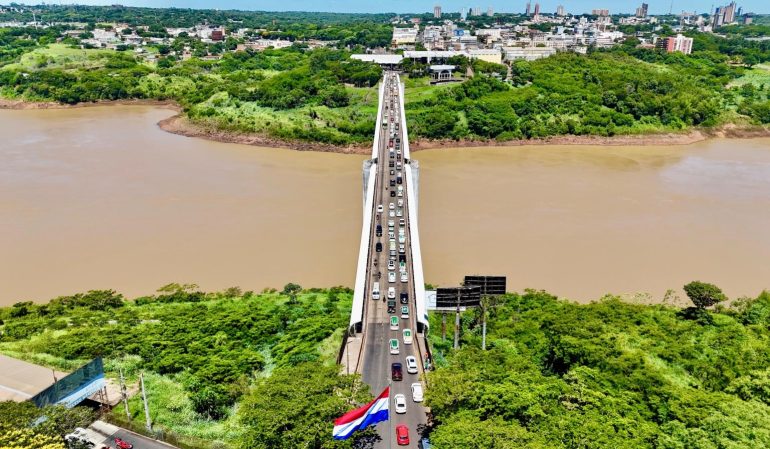

Paraguay’s National Directorate of Migration continues reinforcing border controls during the busy end-of-year travel season. The ongoing operation follows actions taken during the Copa Sudamericana final. The operation’s main goal is to ensure safer, more organised, and faster crossings. According to Migration Director Jorge Kronawetter, travel volumes are significantly increasing towards Brazil and Argentina.
Increased surveillance at major crossings
At the country’s main border points, additional officers have been deployed to manage the rising number of travellers. Meanwhile, random checks have been reactivated near the Puente de la Amistad, the busiest crossing with Brazil. This measure strengthens the institutional presence in an area operating under the free transit regime. As a result, authorities aim to keep flows orderly despite higher traffic.
In addition, the operation addresses the increase in school excursions and end-of-year trips. During this period, buses filled with students cross daily towards neighbouring countries. Therefore, officials are prioritising efficient document verification. These efforts reduce queues and prevent unnecessary delays.
Free transit rules and unified border controls
Although registration is not mandatory in countries under the free transit agreement, such as Brazil and Argentina, all travellers must carry valid documentation. Both Paraguayan and foreign citizens are required to present identity cards or passports. However, the agreement only applies if travellers enter and leave through the same border crossing.
If a foreign tourist enters through one point and exits through another, registration becomes mandatory. Otherwise, the individual may face a fine for failing to register the entry. In cities such as Encarnación and Posadas, controls are unified on the Argentine side. This applies to both road and railway crossings via the international train service.
Key recommendations for families and students
Migration authorities remind families that minors must carry proper identification and proof of relationship. When travelling with only one parent or with third parties, legal authorisation is required. This document must be issued by a Peace Court and legalised by the Supreme Court.
In special situations, a judicial authorisation is necessary. Additionally, all permits must be apostilled for use in Brazil or Argentina. To speed up transit, closed passenger lists may be used for large groups. Therefore, travellers are encouraged to organise documents in advance and keep them accessible at all times.