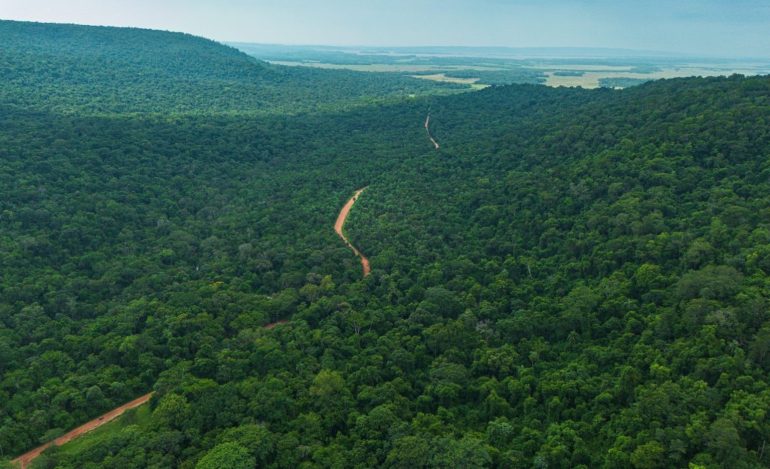

Paraguay has maintained 44.4% of its territory with forest cover, equivalent to 17.76 million hectares, according to a new national report of Paraguay’s National Forestry Institute (Infona). The new Infona report findings, published in February 2026, also state that deforestation was on a sustained downward trend during the 2022-2023 period, with the rate of land use change for native forests reaching its lowest point in nearly two decades.
The data is detailed in the National Report on Forest Cover and Land Use Change 2022-2024. The document shows that native forests constitute the vast majority of this coverage, accounting for 82.7% of the national total. These crucial ecosystems are primarily concentrated in the country’s Western Region.
At the same time, Paraguay’s forestry sector surpassed US$100 million in exports in 2025, marking a record year for the industry, according to Infona data. The milestone reflects strong international demand, particularly for plywood shipments.
A strategic tool for national policy
During the new Infona report’s virtual presentation, the president of the National Forestry Institute (Infona), Cristina Goralewski, expressed the strategic importance of the findings. She emphasised that the document strengthens Paraguay’s forestry baseline with official, and internationally comparable data.
“It is a fundamental tool for public decision-making, access to demanding markets, and the planning of long-term forest policies,” Goralewski stated.
A historic growth in forest plantations,
In addition to the positive trend in conservation, the report highlights other significant developments. It notes a historic growth in forest plantations, which have expanded by 66.1% in only two years. Furthermore, the document underscores the strategic role of palm groves, which represent 15.4% of the national forest cover. Approximately 94% of these palm groves are concentrated in Paraguay’s Western Region.
Enhanced monitoring and accuracy
The 2022-2024 report incorporates significant methodological improvements that have greatly enhanced the precision of its data. Key among these updates is the reduction of the minimum mapping unit from one hectare to 0.5 hectares. This change allows for a more detailed and accurate analysis of forest cover changes across the country.
Moreover, the updated methodology removed a filter that was based on historical native forest maps, a move that has significantly increased the accuracy of the monitoring system. Consequently, Infona states that the forest map now achieves a global accuracy of up to 98.2%, with a concordance index that is described as being close to perfection. These technical advancements ensure the reliability of the report’s conclusions.
Strengthened enforcement and control
Regarding the dynamics of forest use, the report confirms that the 87.4% of land use changes involving native forests in the Paraguayan Chaco were conducted under approved land use plans. This high figure reflects a strong level of compliance with the national regulatory framework.
The success of this improved system, according to Infona is evident in enforcement statistics. Reports from Infona’s Early Warning System increased by 47% between 2023 and 2024. In the same period, complaints associated with land use changes and punishable offences rose by more than 150% between 2022 and 2024, indicating greater public and institutional vigilance.