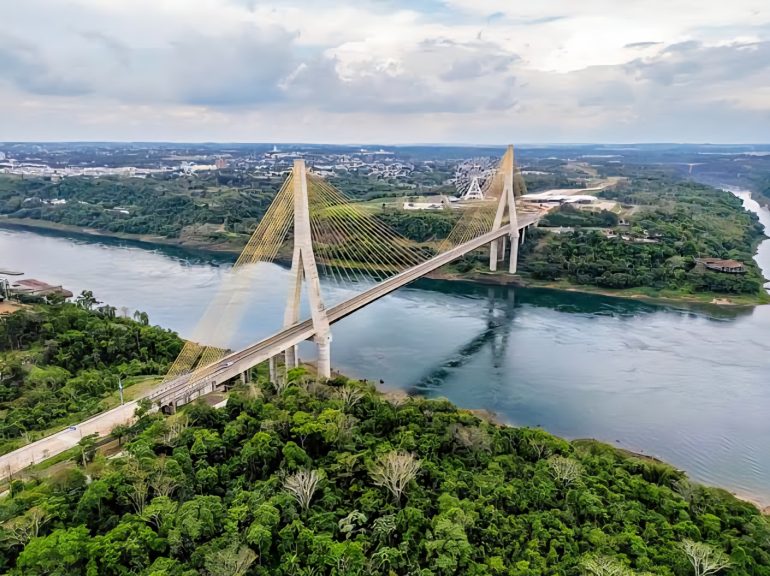

The skyline over the Paraná River has changed forever. After decades of anticipation and six years of demanding construction work, the Paraguay-Brazil Integration Bridge (Puente de la Integración) has ceased to be an engineering promise, and has become a reality.
On 20 December, 2025, Paraguayan President Santiago Peña officially inaugurated this colossal structure linking the cities of Presidente Franco (Paraguay) and Foz do Iguaçu (Brazil), marking the beginning of a new era in South American connectivity. The Integration Bridge helps to relieve congestion on the Friendship Bridge, the only current crossing between the two nations.
A landmark between diplomacy and concrete
The inauguration was not without political nuance. In an unusual development, the official ceremonies were held separately. While Brazilian President Luiz Inácio Lula da Silva led an event on the Brazilian side on Friday, Santiago Peña did the same on Saturday from Presidente Franco.
President Peña did not conceal his dissatisfaction with the absence of a shared agenda for an event of such magnitude. Nevertheless, beyond the diplomatic disagreements, the central message was one of optimism: the bridge represents the “maturity” of a bilateral relationship in which the progress of one country directly feeds the success of the other.
Paraguay-Brazil Integration Bridge: Anatomy of a giant
The Integration Bridge is a symbol of modernity, designed to relieve the historic Friendship Bridge, currently overwhelmed by the daily flow of 30,000 vehicles.
- Investment: Approximately US$84 million, financed by the left bank of ITAIPU.
- Dimensions: 760 metres in length, with a main free span of 470 metres without pillars over the river.
- Strategic location: It directly connects the Paraguayan Alto Paraná Department with the state of Paraná, aiming to decentralise the severe traffic congestion of the Paraguayan city of Ciudad del Este.
Pilot plan: a cautious beginning
To ensure a smooth transition and avoid overwhelming the urban arteries of Presidente Franco, the authorities have designed a gradual opening scheme:
- Initial phase: Crossing is restricted exclusively to unladen lorries.
- Night-time operation: The bridge operates from 19:00 to 07:00.
- Urban restriction: Within the internal streets of Presidente Franco, lorries may circulate only between 22:00 and 05:00 in order to protect residents’ rest and safety.
- Next steps: Within thirty days, tourist coaches are expected to be authorised. Through diplomatic efforts already initiated by Foreign Minister Rubén Ramírez, permission is also being sought for light vehicles to cross twenty-four hours a day.
Paraguay’s Minister of Public Works (MOPC), Claudia Centurión, explained that the project addresses a clear need to strengthen logistical connectivity, and to deliver modern infrastructure for the movement of people and goods.
The future of the region
The opening of the bridge is accompanied by the inauguration of the new Presidente Franco Border Centre, which is essential for customs and migration controls. Furthermore, this project forms part of a larger puzzle that includes the future Bioceanic Bridge, currently under construction, consolidating Paraguay as a regional logistics hub.
For the residents of the Triple Frontier, the bridge is more than asphalt; it is the promise of new jobs, a tourism boost, and above all, the reduction of those endless hours of waiting to cross a border.