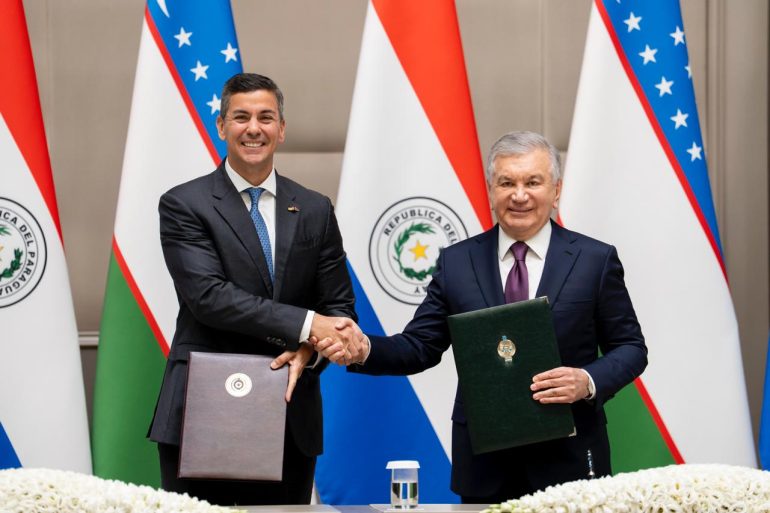

On December 11, 2025, Paraguayan President Santiago Peña arrived in Tashkent, making this the first official visit by a Latin American head of state to Uzbekistan. For Paraguay, it marked the country’s growing presence in a new region. For Uzbekistan, it was a sign of its expanding global partnerships.
Paraguay and Uzbekistan established diplomatic relations in 2001, but for more than twenty years those remained limited. There were no major high-level meetings, trade turnover was very small, and communication mostly consisted of exchange of letters during national holidays. In recent years Uzbekistan’s foreign policy under President Shavkat Mirziyoyev began shifting toward multi-vector engagement, aiming to strengthen ties with traditional partners while expanding Uzbekistan’s presence in regions such as Latin America. According to Uzbek state media, bilateral trade in 2024 reached around US$700,000.
“A historic visit”
President Mirziyoyev called the visit “historic,” noting again that Paraguay had become the first Latin American nation to send a President to Uzbekistan. He praised Paraguay’s open economy, macroeconomic stability, and emphasised that both countries are landlocked, which naturally shapes their economic strategies, and makes their development visions surprisingly compatible.
For Paraguay, the visit also mattered because it opened doors in new economic directions. President Peña stated that although the two countries are geographically far apart, they share the same aspirations: prosperity, stability, and modern development. He highlighted that Paraguay’s decades of experience in agriculture and energy align well with Uzbekistan’s strengths in industry, innovation, and regional connectivity. This complementarity gives both
sides new opportunities for growth.
A Joint Statement, and Memorandum of Understanding
Several concrete results came out of the high-level talks. The two presidents signed a Joint Statement outlining the next stage of bilateral cooperation. A Memorandum of Understanding between the Foreign Ministries set up a system for regular political consultations, giving the relationship a more structured foundation.
One of the most important outcomes was the signing of a protocol finalising bilateral negotiations on Uzbekistan’s accession to the World Trade Organization (WTO), a step that will make trade between the two countries easier and more predictable, and offers Paraguay a new partner within the global trading system.
Both leaders also agreed to expand work in trade and investment, with immediate priorities in agriculture, food processing, and chemical industries. They also identified digitalisation, tourism, and sports as promising spaces for future projects. As a part of the official visit, President Peña participated in the General Assembly of the International Automobile Federation (FIA) in Uzbekistan as well, and received the World’s Best Rally Award For 2025 at the FIA Gala. This was also mentioned during the high-level talks.
A country on the rise
Today, Uzbekistan is a country of more than 38 million people located at a strategic crossroads between East and West. Between 2017 and 2024 alone, the country attracted more than US$113 billion in investment. With its rich history and unique culture, the country has also become one of the top travel destinations in the region, attracting almost 10 million foreign travelers last year.
This year, Uzbekistan hosted the 43rd UNESCO General Conference, the first time since 1985 that the event was held outside UNESCO’s headquarters in Paris.
Overall, President Peña’s visit introduced a new geography of cooperation for both countries and built the foundation of cooperation between Latin America and Central Asia. Moreover, it transformed a long-standing but distant diplomatic bond into a strategic partnership built on shared interests, mutual respect, and a clear, future-focused vision.
Written for The Asunción Times by Adkhamjon Janobiddinov, an independent Uzbek researcher and writer specialising in Central Asian affairs.