
In the southern Paraguayan department of Misiones, the quiet rural community of Tañarandy becomes the stage for one of the most striking cultural and religious expressions in the country. The name itself, derived from the Guaraní language, means “Land of the Irreducible”, a reference that evokes both historical resilience and a deep spiritual identity.
Every year during Holy Week, thousands of visitors travel to the district of San Ignacio Guazú to witness a celebration that transcends the boundaries of conventional religious ceremonies. What unfolds in Tañarandy is not merely a procession or a theatrical representation, but a collective act of devotion in which faith, art and community converge.
Although Holy Week is widely observed throughout Paraguay with prayers, processions and family gatherings, Tañarandy has emerged as one of the most emblematic places to experience the spiritual intensity of the season.
Where faith meets art
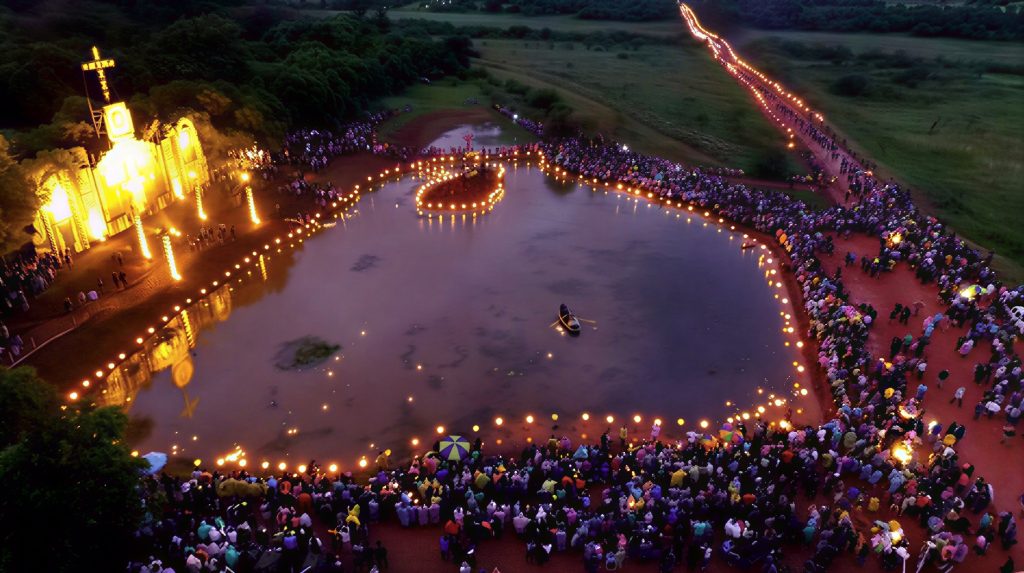
The celebration in Tañarandy represents a remarkable fusion of popular religiosity and artistic creativity. Over time, it has become a cultural phenomenon attracting visitors from Paraguay and abroad to experience its unique atmosphere.
The central events occur on Good Friday, when residents and pilgrims gather to commemorate Christ’s Passion and death. The community transforms the landscape into an open-air stage, retelling sacred history through artistic expression.
Through carefully prepared scenes, dramatic lighting, and music, Christ’s suffering is presented in a visually powerful and deeply emotional way. The result is an experience that appeals not only to religious devotion but also to artistic sensibility.
The path of light: Yvága Rapé
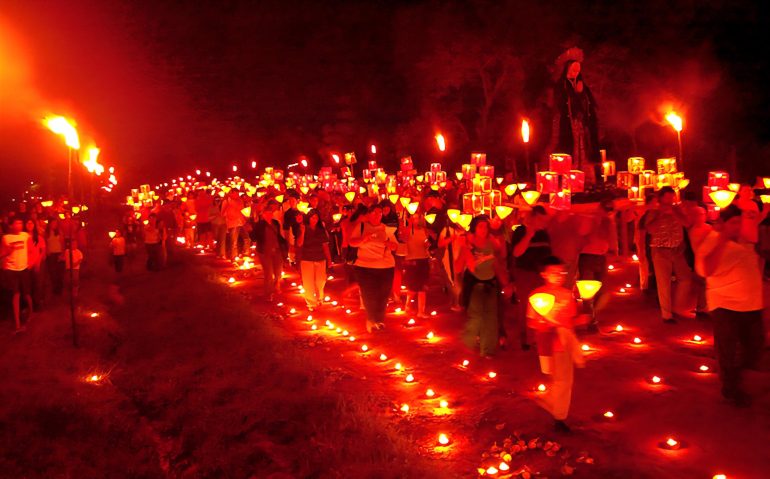
One of the most memorable moments begins at sunset, when the main Good Friday procession sets out along a rural road known as Yvága Rapé, a Guaraní phrase meaning “the road to heaven”.
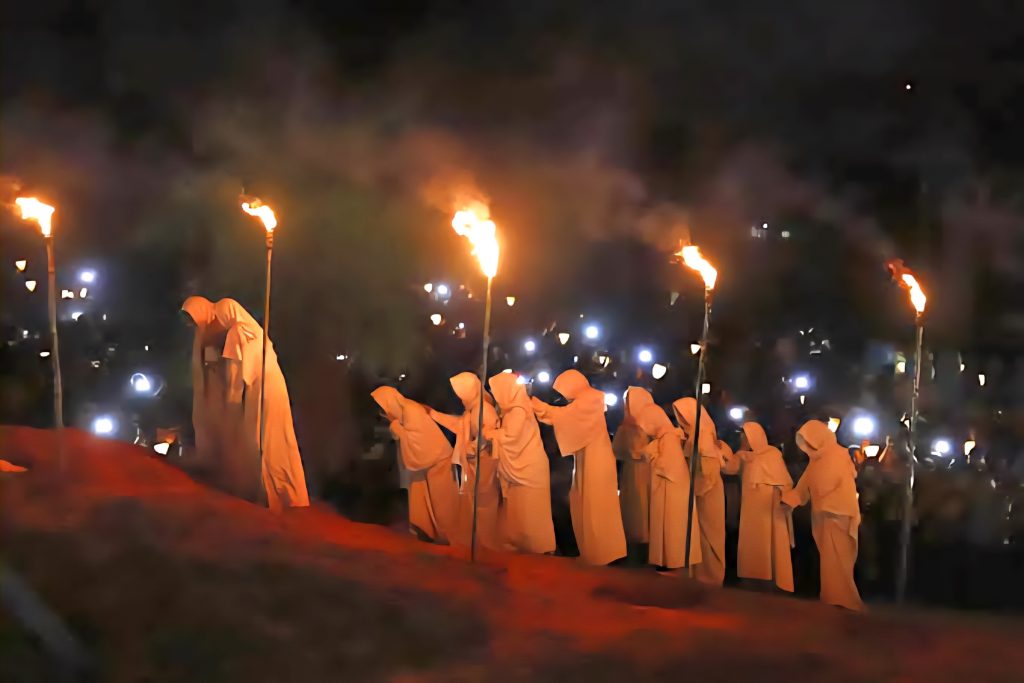
As darkness falls over the countryside, the path is illuminated by thousands of candles and traditional lanterns carried by participants. Large torches line both sides of the road, casting flickering shadows across the reddish dust typical of the region.
The procession advances slowly, creating a striking visual spectacle. The flames of the lanterns and torches break the darkness, forming a glowing corridor that guides the faithful towards the final destination of the pilgrimage.
For many visitors, walking along this luminous path becomes one of the most powerful aspects of the experience, transforming the rural landscape into a space of contemplation and reflection.
The living paintings of La Barraca
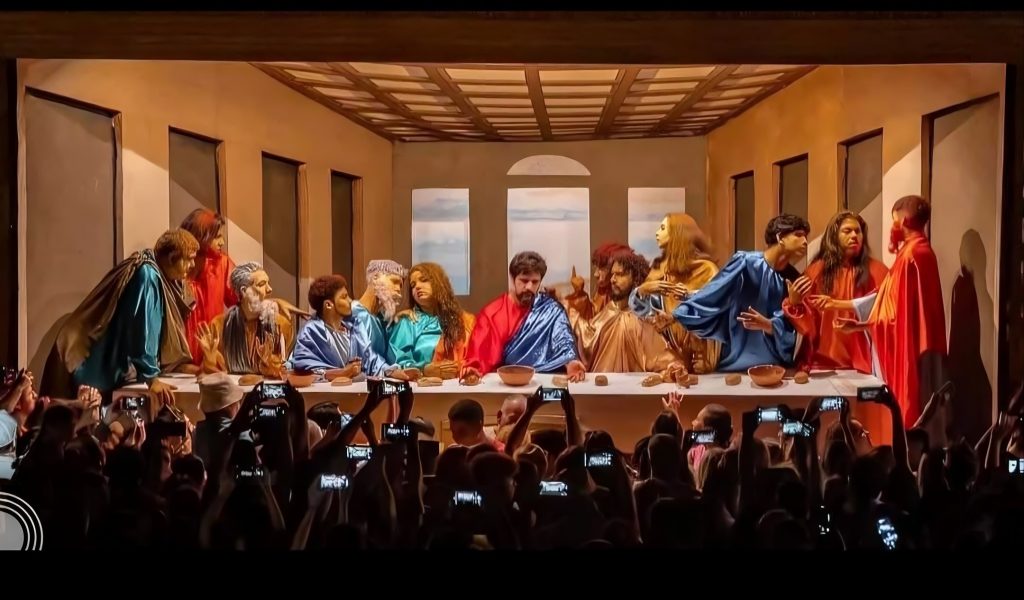
The culmination of the procession takes place in an open space known as La Barraca, a natural amphitheatre where the most anticipated part of the event unfolds. Here, local residents present what are known as living tableaux, dramatic recreations of scenes from the Passion of Christ.
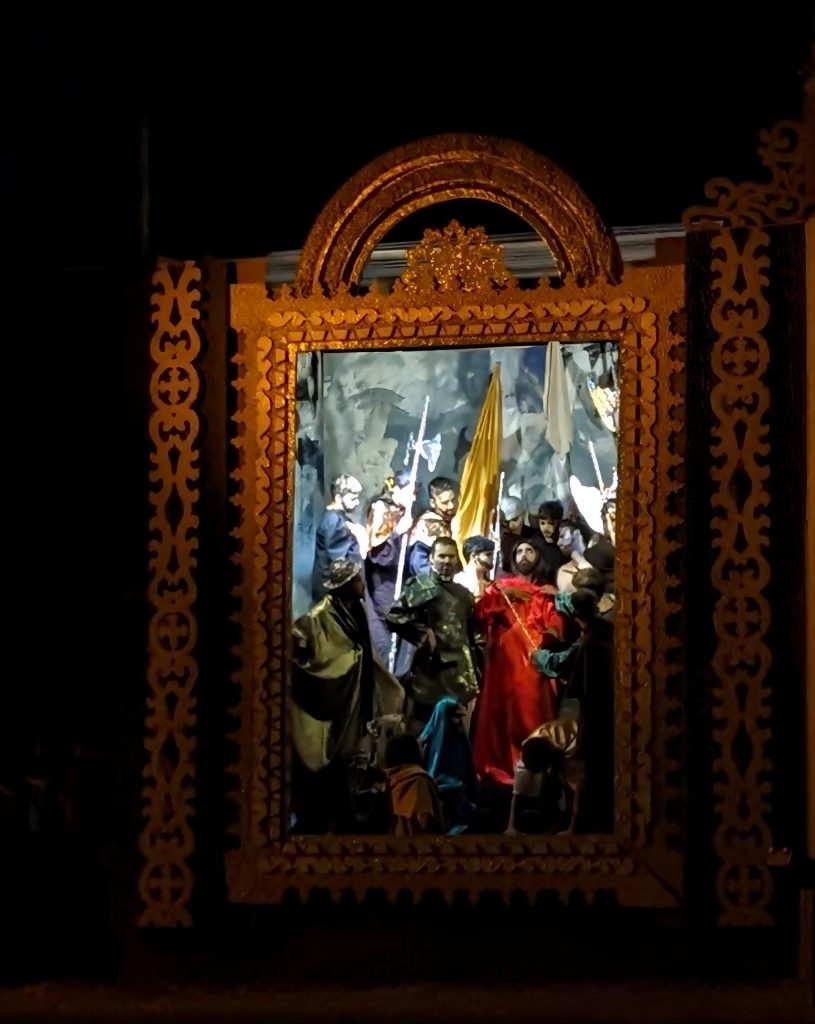
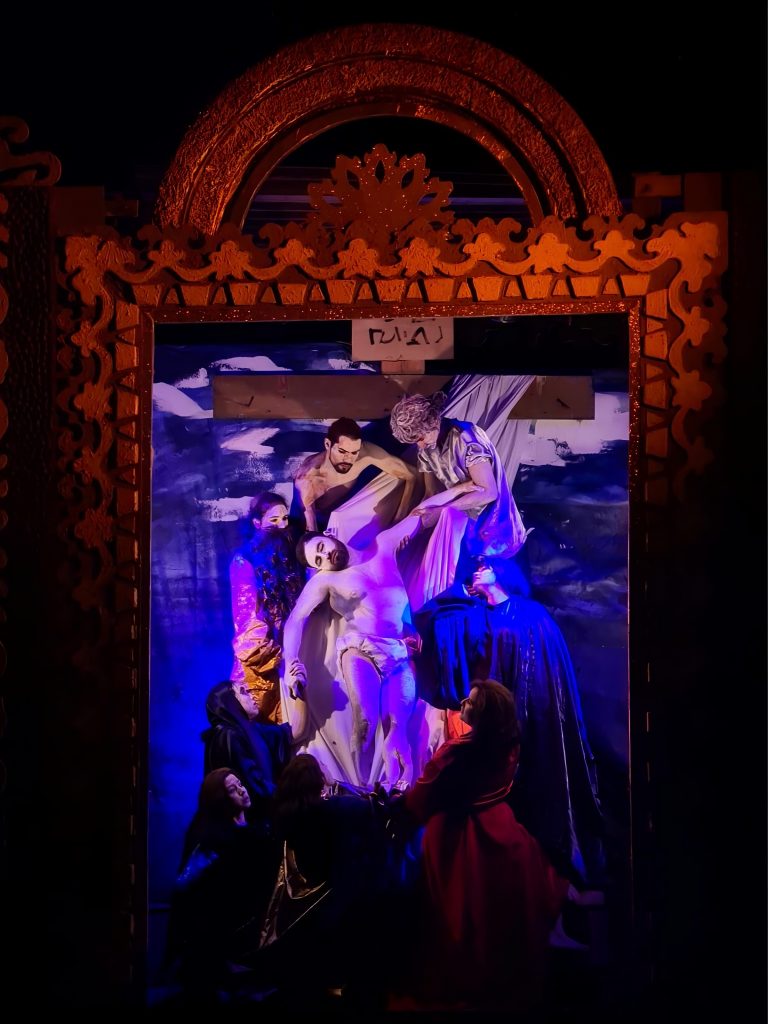
The performers remain still for long periods, carefully reproducing famous religious artworks through posture, costume and lighting. Each year the scenes change, often drawing inspiration from renowned works of sacred art. Among the scenes represented are the arrest of Jesus, the crucifixion, the descent from the cross and the sorrowful image of Michelangelo’s Pietà (The Mercy).
The effect is both theatrical and contemplative. Performers create living images that invite reflection on each moment’s artistic and spiritual significance, rather than narrating events.
The vision of Koki Ruiz
The modern tradition of Tañarandy owes much to the vision of Paraguayan artist Delfín Roque Ruiz Pérez, widely known as Koki Ruiz. In 1992 he began organising the Good Friday celebration with members of the community, initially as a small local initiative.
Ruiz envisioned a celebration that would combine religious devotion with large-scale artistic expression. Over time, his project grew into a major cultural event that draws thousands of visitors every year.
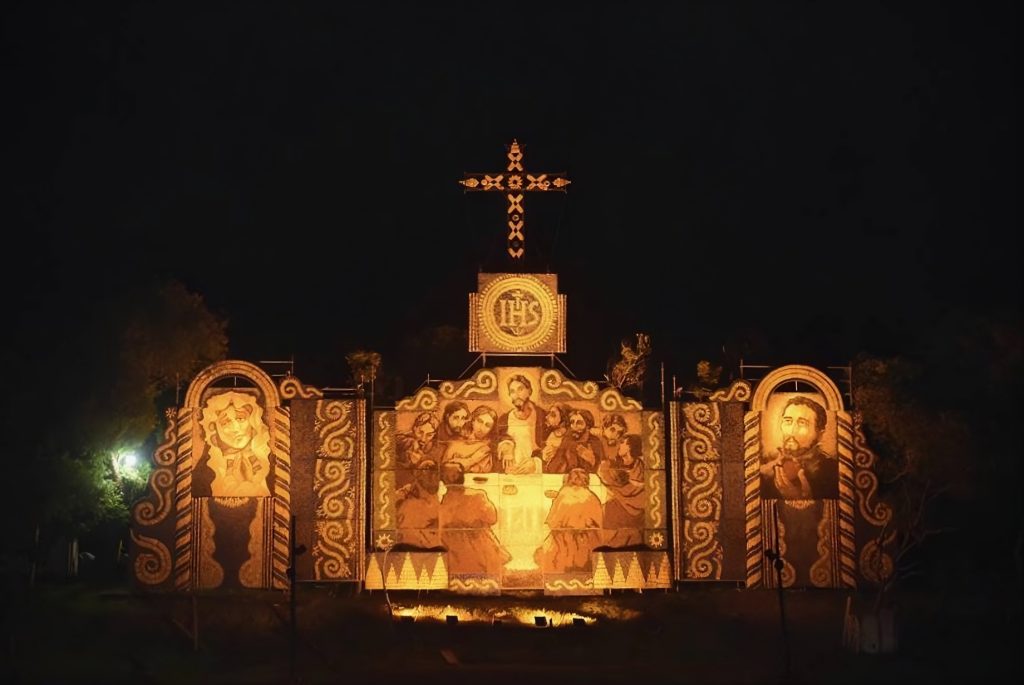
Following his death in 2024, responsibility for continuing the tradition passed to his daughters, Almudena and Macarena Ruiz. Both artists now lead the preparation of the living tableaux and oversee the artistic direction of the celebration.
While they seek to preserve the spirit of their father’s work, they also introduce new interpretations and creative elements, ensuring that the tradition continues to evolve while remaining faithful to its origins.
A tradition of community
Months before Holy Week arrives, the preparation for Tañarandy begins. Residents collaborate in building lanterns, preparing torches and constructing the stage elements required for the living tableaux.
The work is largely voluntary, reflecting the strong sense of community that defines the celebration. Families, artists and neighbours all contribute to the event, transforming it into a collective effort that strengthens local identity.
The growing number of visitors has also turned Tañarandy into an important cultural destination during Holy Week. Hotels and guesthouses in nearby San Ignacio Guazú often fill months in advance as visitors plan to witness the celebration.
Yet despite its growing popularity, the essence of Tañarandy remains rooted in faith and communal participation. What began as a small artistic initiative has become one of Paraguay’s most evocative cultural traditions.
Every Good Friday, as night falls over Misiones’ red earth, thousands of flames illuminate the road to La Barraca. Along that glowing path, devotion, memory and art come together to create a spectacle that is both spiritual and profoundly human.