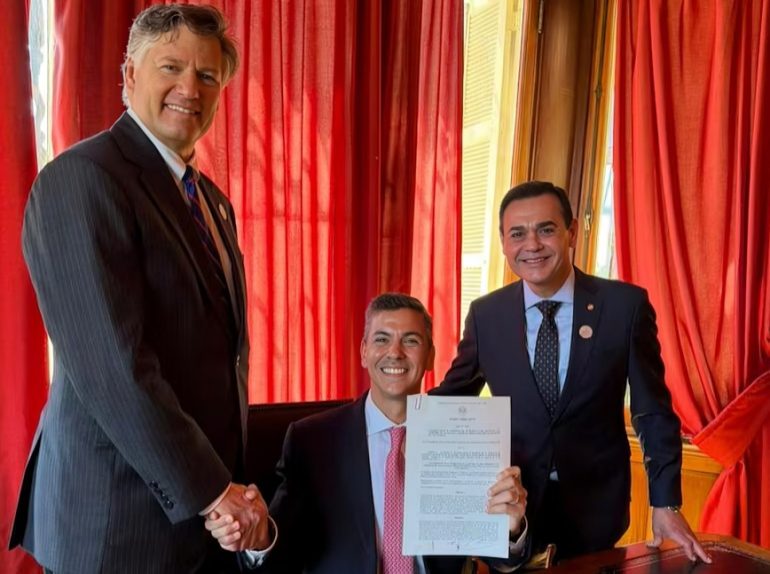

Paraguayan president Santiago Peña signed the Status of Forces Agreement (SOFA) agreement between his country and the United States, which regulates the temporary presence of U.S. military and civilian personnel in Paraguay. The bilateral defense pact allows activities such as joint training, military exercises, technical assistance, and cooperation against organised crime, terrorism, and transnational threats, while prohibiting permanent U.S. military bases or joint combat operations on Paraguayan soil.
The agreement grants U.S. personnel certain privileges and immunities (similar to diplomatic ones under the Vienna Convention), including U.S. criminal jurisdiction over them in many cases, which has sparked controversy over sovereignty and potential limits on Paraguayan prosecution of crimes committed by Americans in the country.
Status of Forces Agreement approval
The agreement was initially signed by representatives from both nations in Washington last December. It establishes a clear legal framework to govern the presence of US security forces while operating in Paraguay. Paraguay’s lower house of parliament, the Chamber of Deputies, approved the significant defence agreement in March 2026 with a substantial majority. Lawmakers voted 53 in favour and eight against, with an additional four abstentions. With fifteen deputies not present for the vote.
The agreement’s full passage through the Paraguayan legislature was not without contention. The Paraguayan Senate also approved the treaty, but the debate there was described as significantly more polarised. Many of the concerns raised by opposition senators and civil groups centred on potential infringements upon national sovereignty. The issue of legal immunity for foreign troops proved to be the most controversial aspect of the discussions.
Political debate and sovereignty concerns
A particularly notable provision within the agreement authorises the United States to retain criminal jurisdiction over its personnel while they are stationed in Paraguay. This means that any American military or civilian staff accused of committing a crime would be subject to the U.S. legal system rather than Paraguayan courts. This element has been a focal point of much of the political and public debate surrounding the treaty.
Critics argue that granting foreign personnel immunity from prosecution, which is equivalent to the legal protection given to diplomatic staff, fundamentally undermines Paraguayan legal authority and institutions. Also, U.S. Department of Defense personnel and U.S. personnel shall not be responsible for paying any taxes or similar charges applied within the territory of Paraguay.
Government and US support for the pact
Despite these criticisms, the Paraguayan government has strongly and consistently supported the agreement. In December 2025, Foreign Minister Rubén Ramírez Lezcano defended the pact, arguing its primary objective is to enhance cooperation between the United States and Paraguay.
“President Santiago Peña is extremely committed to continuing to work strongly on the relationship between our countries,” Paraguay’s foreign minister stated. “But also on shared objectives, which proposes that we continue fighting against transnational organised crime; continue working strongly against drug trafficking, against human trafficking, against corruption, which are all relevant aspects, but above all, for the freedom of our people.”
Moreover, Lezcano sought to reassure the public and political opponents by explicitly stating that the agreement does not permit the establishment of permanent American military bases on Paraguayan soil.
Civil society response and regional context
Both he and the U.S. State Department have praised the signing of the Status of Forces Agreement as “historic”. This sentiment was echoed by U.S. Secretary of State Marco Rubio, who also described it as a “historic agreement” that “would greatly benefit mutual interests”.
According to Rubio, the pact will help facilitate a range of joint activities, including bilateral and multinational training, humanitarian aid, and disaster response operations. He emphasised that it would support other shared security interests in the region. The approval of SOFA occurs as Washington actively seeks to expand its influence in Latin America, which is a stated goal of the Trump administration’s national security strategy.
Also read: Paraguay And United States Sign Historic Pact To Tackle Irregular Migration.