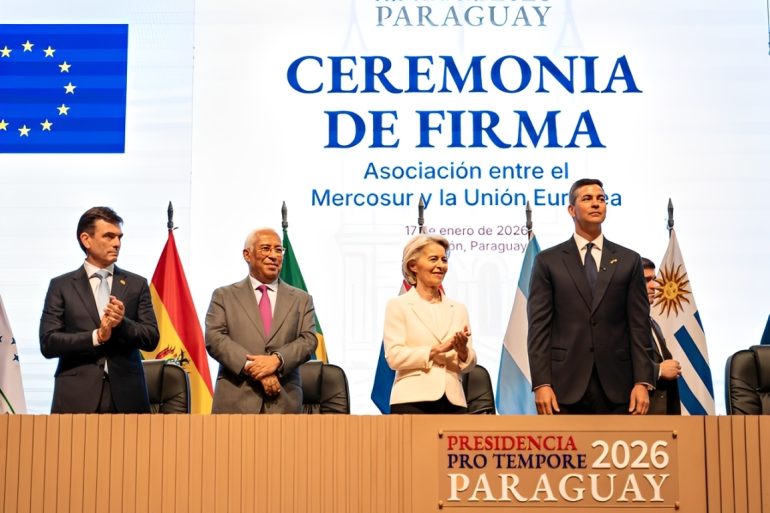

The European Union (EU) and South America’s Mercosur bloc have formalised a sweeping trade deal in Asunción, Paraguay, on 17 January 2026, concluding 25 years of negotiations. The EU-Mercosur trade deal establishes an integrated marketplace encompassing roughly 700 million consumers and creates reciprocal market access between two major economic regions.
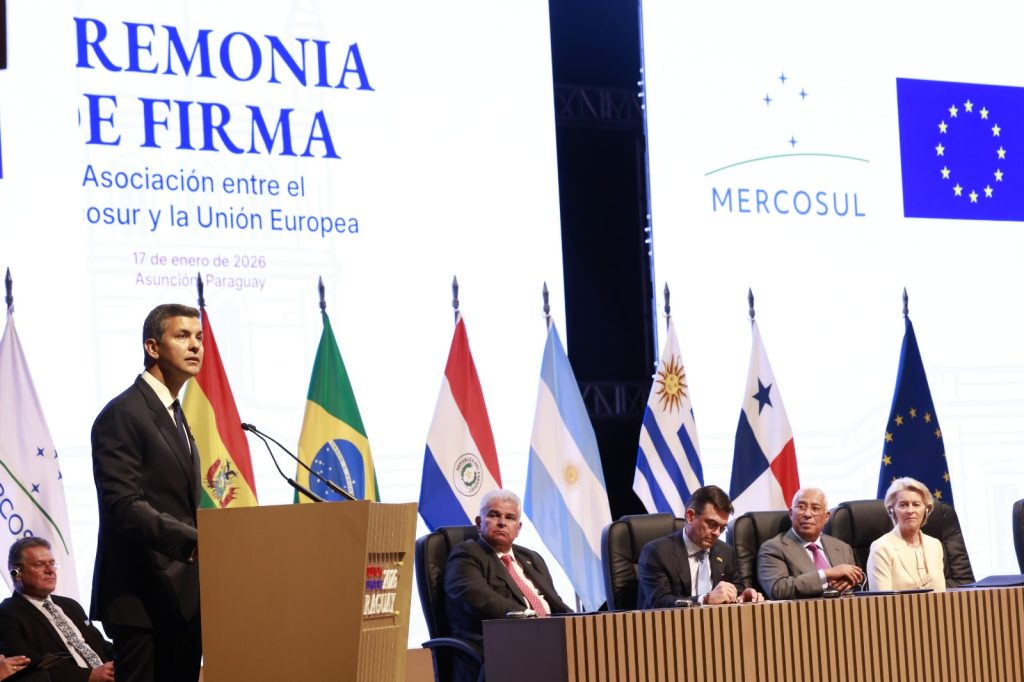
The two blocs are now poised to reshape global trade patterns with one of the largest free-trade zones ever created. Presidents from Argentina, Uruguay, Bolivia, and Panama attended alongside senior European officials. EU chief Ursula von der Leyen characterised the moment as embracing open commerce and sustained partnerships. Antonio Costa, head of the European Council, highlighted the accord’s affirmation of multilateral frameworks grounded in international law.
Expanding market access for both regions
The EU-Mercosur agreement systematically dismantles approximately 90% of tariffs across manufacturing, services, and agricultural sectors. Mercosur figures indicate the EU will eliminate duties on 92% of South American exports, valued at nearly US$ 61 billion. An additional 7.5% of shipments, worth approximately 4.7 billion dollars, receive preferential commercial terms. The bloc gains entry to the European Union, the world’s third-largest economy with 450 million inhabitants. The EU represents approximately 15% of global economic output. This market access expands possibilities for South American manufacturers, agricultural producers, and service enterprises.
European businesses gain enhanced opportunities through expanded market entry. The European Commission projects annual tariff savings exceeding four billion euros. European exports to Mercosur territories are anticipated to grow 39%, reaching 48.7 billion euros by 2040. Latin American shipments to Europe are expected to increase 16.9% to 8.9 billion euros.
Strategic elements and cooperative mechanisms
Both regions secured defined advantages alongside tariff modifications. The EU-Mercosur agreement protects 344 regional product designations, such as champagne and Parmigiano-Reggiano, against unauthorised imitation, reinforcing European producers’ intellectual property protections. The arrangement also strengthens European sourcing of critical minerals, reducing reliance on Chinese supplies.
South American nations obtained improved frameworks for economic participation. Mercosur countries have opened government procurement markets to European enterprises on comparable terms as domestic suppliers, creating fresh investment pathways. Both blocs established cooperation mechanisms addressing development priorities across multiple economic sectors. According to an official Mercosur statement, the accord establishes an integrated framework advancing goods and services exchange, investment flows, and economic expansion whilst generating concrete benefits for citizens and enterprises across the region.
Agricultural protections and internal debates
The accord incorporates substantial provisions addressing European agricultural sector concerns. Beef entering the EU from Mercosur will not exceed 99,000 tonnes annually, subject to a reduced tariff of 7.5%, representing only 1.5% of European beef production. Poultry faces an annual ceiling of 180,000 tonnes, constituting merely 1.3% of EU output.
Significant perspectives diverge within the European Union regarding the agreement’s implications. Germany and Spain champion the accord, contending that Europe requires expanded commercial partnerships as the United States restricts market entry and China pursues increasingly assertive trade strategies. France raised substantial concerns, arguing the pact may expose European farming communities to intensified competitive pressures.
France negotiated a safeguard mechanism permitting tariff reimposition should Mercosur shipments increase beyond 5% in vulnerable agricultural categories. Italy, initially hesitant, supported the agreement after securing agricultural funding beginning in 2028 and exemptions from carbon taxation on fertiliser products.
For Mercosur members, the agreement represents successful regional negotiation outcomes and reinforces the bloc’s capacity to establish balanced commercial relationships with major global economic powers.
Parliamentary approval and contested implementation
The signing ceremony marks substantive progress, yet ratification procedures remain pending. The European Parliament must approve before the arrangement becomes operational. Legislative sentiment divides substantially along national lines, creating uncertainty surrounding final endorsement.
European lawmakers face scheduled votes addressing the accord’s implementation. Next week, the European Parliament will vote on a resolution calling for the agreement to be challenged before the EU’s highest court, reflecting ongoing contestation. EU member state support may influence undecided parliamentarians, though parliamentary approval remains uncertain.
As French President Emmanuel Macron noted, the signing does not mark the conclusion of the negotiation process. The EU-Mercosur agreement demonstrates both regions’ capacity to pursue integrated trade frameworks despite competing priorities and domestic political considerations. Successful ratification would deliver anticipated economic benefits for enterprises and consumers across both blocs, whilst addressing persistent concerns from agricultural constituencies and environmental advocates regarding implementation standards and compliance mechanisms.
Read more: Paraguay Joins Nasdaq, Opening Doors To Global Investment And Financial Growth